
Feel Like the Odd One Out in Your Family? What Helps
Updated 2026-11-07
Everyone is at the table. Someone passes the potatoes, someone retells the story that always gets retold, and you laugh in the right places. Nobody is being unkind.
And still, somewhere in the middle of the meal, you feel like a guest who has been very warmly welcomed into someone else's house.
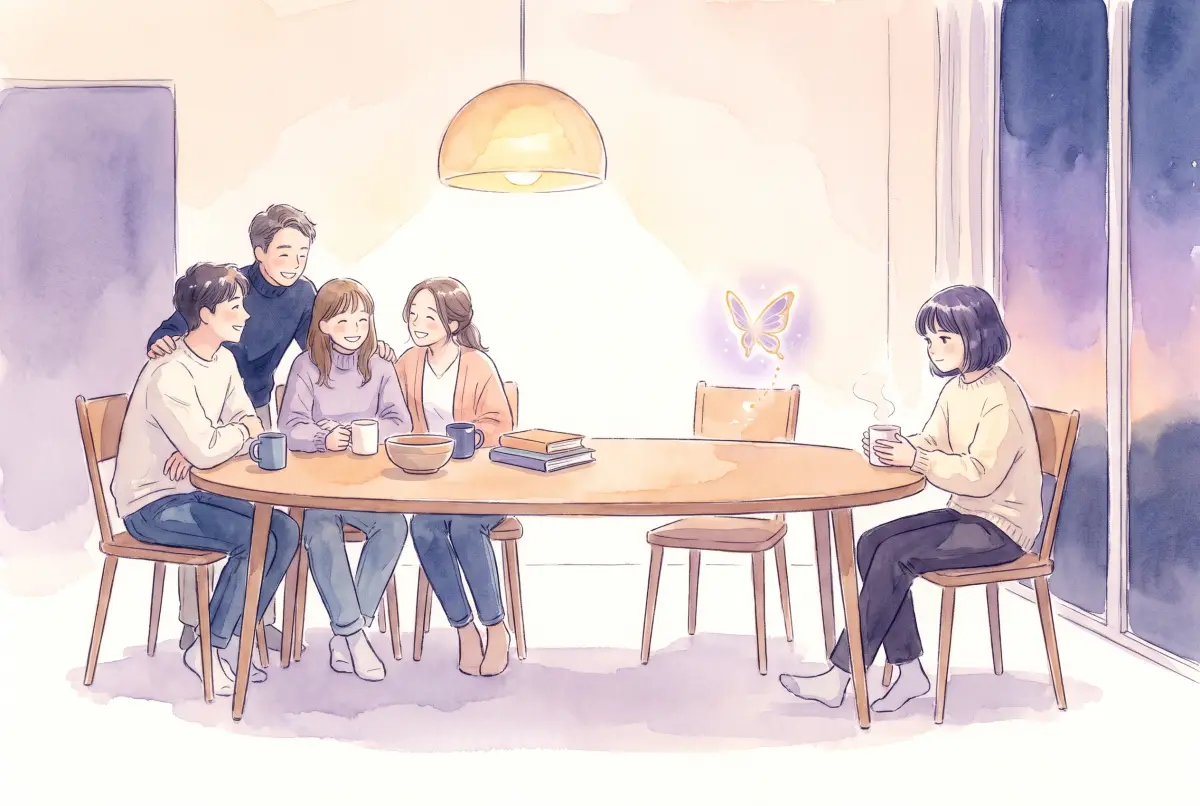
If that is familiar, you are not being dramatic, and you are not ungrateful. This is one of the quieter kinds of loneliness, and it is easy to miss because everything looks fine from the outside.
You can be loved and still feel like a guest
Most of us assume that family is where we automatically belong. So when you feel out of place there, it can seem like a verdict: either they are failing you, or you are failing at being part of them.
It helps to pull two things apart. Being loved and being known are not the same experience.
In a classic review of the research on belonging, Baumeister and Leary argued that people have a deep need for frequent, warm interactions within an ongoing relationship where they feel cared about. The need is not just to have people around, but to feel like part of something with them.
That is a theoretical framework drawing on many studies, not a measurement of your family. But it fits what you may already sense. Sitting near people who love you can still leave the belonging need unmet, if the closeness never quite reaches the parts of you that are different.
Loneliness works the same way. In a review of loneliness and its consequences, Hawkley and Cacioppo note that loneliness is not simply being alone. It is the perception of being isolated, of not having the connection you need. A full house can leave that perception in place.
Feeling different is more common than it feels
When you are the one who feels out of step, it is easy to assume everyone else is in step. They usually are not.
In a study of 158 families that included adult sons and daughters aged 22 to 49 and their parents, Birditt and colleagues found that tensions between parents and grown children were normative, meaning ordinary and widespread. Tensions about the relationship itself were linked to lower closeness and more mixed feelings. The authors noted this fits the idea that parents and grown children can be at different stages of life, with different needs.
That study did not ask people whether they felt like the odd one out, so it cannot tell us how common that exact feeling is. What it does show is that friction and mixed feelings between family members are a regular part of family life, not a sign that yours is broken.
A few ways families end up with an odd one out
These are our observations, not research findings, but they come up again and again.
The role you were handed. Somewhere along the way you became the sensitive one, the serious one, the funny one, the one who left. Roles keep families running smoothly, and they also keep people from seeing who you are now. Your role may have stopped fitting while everyone else still talks to the old version.
Different roads. Your values, your work, your faith, your city, who you love, or how you choose to live may be unlike the rest of the family's. Sometimes nobody has to be wrong for that to create distance. Other times the distance comes from not being accepted, and that is not something you have to fix. It can mean you are speaking a different dialect at the same table.
The topic nobody can say. Sometimes there is one subject that sits in the middle of the room and gets stepped around. Everyone is polite, and the politeness is exactly what keeps you from feeling known.
For many families these are about a gap rather than anyone failing, and gaps can sometimes be worked with. When something harder is going on, the sections below apply.
Stop trying to be understood by everyone at once
When we feel unseen, the natural move is to try harder: explain more, argue the point, prove that our life makes sense. It rarely works at a crowded table, and it can wear you out.
Try shrinking the goal. Instead of getting the whole family to understand you, look for the one person who might understand you a little more, or who could.
It might be a sibling you used to trade jokes with, a cousin who also left, a parent at the sink while the others are in the next room, or an aunt who always seemed to see more than she said. Pick the person who feels slightly safer than the rest.
Then offer one small true thing, one degree more honest than your usual answer. Instead of "work is fine," try "work has been a lot lately, and I miss talking to you about real things." You do not have to deliver a speech. You are just leaving a door slightly open.
If you want help with the harder conversations, our guide on talking to your parents about your feelings goes into aiming smaller than one big talk.
Let the family be what it can be
Some of what you want from your family, they may not be able to give. That is a hard thing to sit with, and it is also freeing, because it means the missing piece is not proof that you are unlovable.
If your family is a safe place to stay connected, it can help to ask what they are genuinely good at. Perhaps they are good at showing up, feeding people, or remembering birthdays, even if they are not good at deep conversation. If it feels safe, you can take what is real from them and look for the rest elsewhere.
That "elsewhere" is allowed to be friends, a partner, a mentor, or a chosen family. Building closeness outside your family does not betray the people in it. Most of us need more than one place where we are known.
And if time with your family does not just feel awkward but leaves you ashamed, afraid or worn down, that is a different situation. You are allowed to protect yourself with shorter visits, firmer limits, or more distance, and to lean on people who treat you well. If you cannot leave, small pockets of safety still count.
How Murror can help
The hardest part of this feeling is that it is difficult to say out loud. You cannot lean over at dinner and mention that you feel far away from everyone, so it stays in and starts to harden into a story about you.
With Murror, you open up to a caring AI that helps you understand what you are actually feeling, and the people involved. You might discover that what hurts is not the whole family but one specific dynamic, such as being the "serious one," or one subject nobody touches. Getting clear about that is a real step. It will not fix a family, but it can help you find the words.
Murror also offers gentle insights about your relationships, which can help you notice who you feel more at ease with. From there, Moments to Care and Connections can help you reach out to that person with a short, thoughtful message.
If something you work out in private is worth sharing, you can turn it into an optional takeaway to send to someone you trust. Nothing leaves unless you choose it, and your entries are encrypted and private by default.
Murror is not therapy, and it is not a replacement for the people in your life. It is a place to get clear enough to go back to them with one honest sentence instead of the easy one.
One small thing to try this week
Pick one person in your family who feels even slightly safe. If there is no one, that is allowed too, and the same small message can go to a friend, a mentor or someone in your chosen family. Send them one message that is a bit more real than usual. It could be a memory, a question about their life, or a line like "I was thinking about you, and I would love to catch up properly sometime."
You do not need the whole family to see you. You are allowed to start with a single person, and to let that be enough for now.
Frequently asked questions
Is it normal to feel like the odd one out in my own family?
It is more common than it feels from the inside. Families bring together people of different ages, temperaments and life paths, and one study of parents and grown children found that tension is a normal part of those relationships. Feeling different from the people you grew up with does not mean something is wrong with you, and it does not have to mean something is wrong with them either.
Does feeling like an outsider mean my family does not love me?
Not necessarily. Love and feeling understood are two separate things, and a family can have plenty of the first while the second runs thin. Many people feel cared for and unseen at the same time. It can help to separate the question of whether they love you from the question of whether they know you, because the second one is often more reachable than it looks.
Should I try to make my family understand me?
You do not have to aim for everyone at once. It is usually kinder to yourself to aim for one person and one small true thing, such as a sibling, a cousin or a parent in a quiet moment. Being fully understood by the whole family is a high bar, and chasing it can leave you more tired and more alone. Being known a little more by one person can change how the room feels.
What if being around my family hurts, not just feels awkward?
Feeling unseen and feeling put down or unsafe are different, and the second deserves to be taken seriously. If time with family leaves you scared, ashamed or worn down, it is okay to keep more distance, to shorten visits, and to lean on people outside the family who treat you well. Your wellbeing counts, and wanting space is not a failure of love.