
How Many Friends Do You Need? What Dunbar's Number Says
Updated 2026-10-18
Maybe you scrolled past a post that said everyone should have a certain number of friends, and you started counting. Or someone mentioned "Dunbar's number" at a dinner, and you quietly wondered whether your own circle was too small. Counting the people in your life can make it feel like a test you might be failing. You are not alone in wondering, and the question underneath it is a tender one: do I have enough people who are really mine?
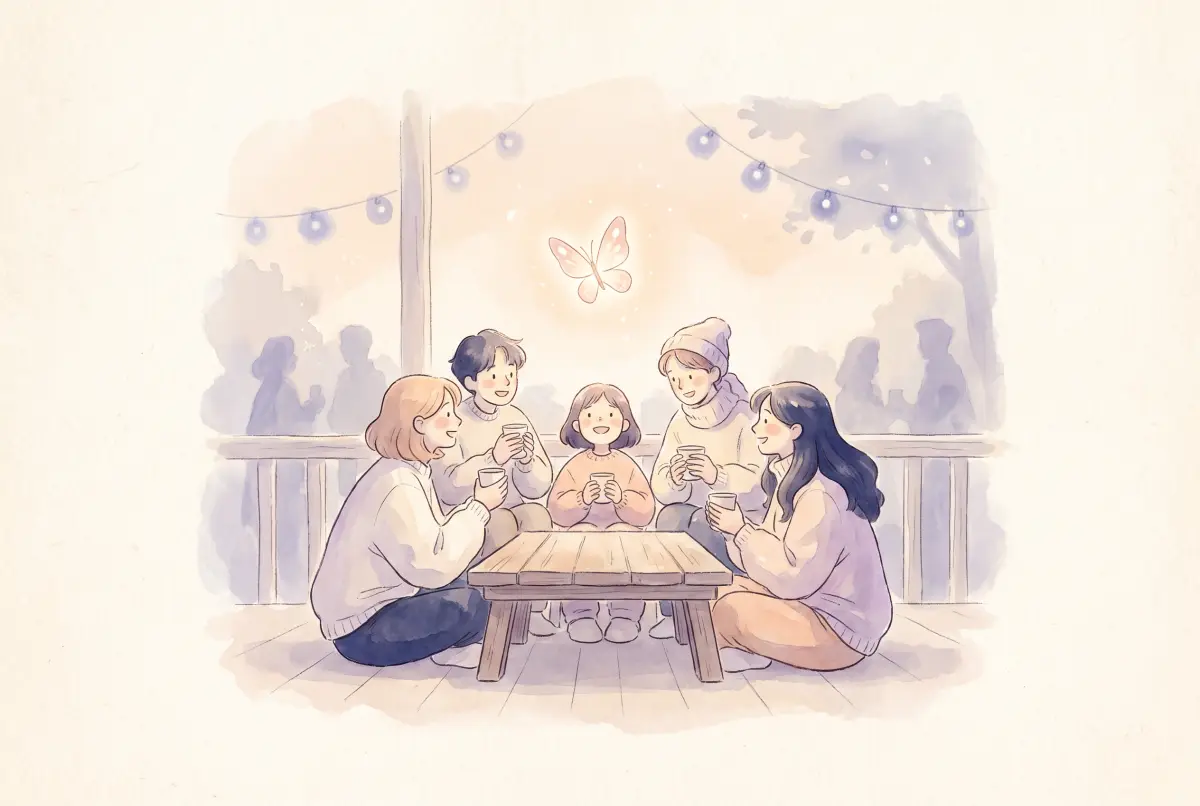
So how many friends do you need? The honest answer is that research has not found a magic number, and the famous one is shakier than it sounds. What the research does suggest is more useful, and kinder. Groups may come in layers, the smallest one in that research was only a handful of people, and the quality of a few relationships may matter more than the size of the whole list. This article walks through what is known and offers better questions to ask than "how many."
Where the number 150 comes from
Dunbar's number is the idea that a person can keep up stable relationships with about 150 people. It traces back to work by the anthropologist Robin Dunbar, who drew a line through the relationship between relative neocortex size and group size in other primates, then extended that line to humans.
It is a memorable idea, and it spread far beyond science. But it has been tested. In a 2021 reanalysis, Lindenfors, Wartel and Lind ran the same kind of primate data through newer statistical methods. Their estimates for average human group size came out wildly different depending on the method, around 69 to 109 with one approach and 16 to 42 with another. The uncertainty around those estimates was enormous, stretching from 4 to 520 in one case and 2 to 336 in the other. The authors concluded that specifying any one number is futile.
So if you have been measuring yourself against 150, you can put that number down. It was never a target, and on this evidence it is not even a reliable estimate.
Another idea: groups may come in layers
The single number did not hold up, but another idea from the same field may be more useful. It is the idea that relationships are not one big pile. They come in rings.
In a study of human grouping patterns, Zhou, Sornette, Hill and Dunbar (2005) combined data on how people form groups and found sizes clustering in steps, each roughly three times the one before it: around 3 to 5, then 9 to 15, then 30 to 45, and so on outward. These were patterns in pooled data, not a rule about any one person.
What makes this worth knowing is the size of that innermost ring. In those data, the smallest preferred group was about 3 to 5 people. Not dozens. If you can think of two or three people you would call when something big happens, you are not falling short of some standard. That is a small number, and small can be enough.
The outer rings matter too. The coworker you joke with, the neighbor who waves, the cousin you see twice a year all add warmth to a life. They just ask for, and give, something lighter.
A smaller circle is not always a loss
People sometimes notice their circle shrinking and read it as failure. Research on how networks change across adulthood suggests a different story.
English and Carstensen (2014) followed adults across a wide age range over time. Social networks tended to grow in young adulthood and then get smaller through later life. But the people who dropped away were mainly peripheral contacts. The number of close partners stayed relatively stable. In a comparison between age groups at one point in time, older adults reported that their networks brought them more positive and less negative emotion. Separately, the emotional tone of a person's network was associated with the emotions they reported.
Read gently, it suggests a shrinking circle does not have to mean losing your closest people. For some it may mean more time with people who feel good, and for others the loss is real and deserves care.
Quantity early, quality later
One long study adds a twist about timing. Carmichael, Reis and Duberstein (2015) followed people for 30 years. They measured social activity at age 20 and age 30, then looked at how participants were doing at 50, including friendship quality and loneliness.
The amount of social interaction at 20, but not its quality, was associated with better outcomes at midlife. At 30 it flipped: the quality of interactions, not the amount, was what predicted how people were doing. One possible reading is that early adulthood may be a time for meeting a wide range of people, and later years a time for going deeper with some of them.
This is one group of people followed over time, and the findings are associations, not proof. It does not mean a quiet twenties decides your future, or that a busy calendar at 35 is a waste. If you are in your twenties with a small circle, this is not a deadline, and people can meet new people at any age. It does suggest that once you are past the season of meeting everyone, the question shifts from "how many" toward "how close."
Better questions to ask than how many
If counting is not the right test, what is? Here are a few questions that get closer to what matters. Answer them for yourself, privately, without grading.
- Who would you tell first? If something big happened tonight, good or bad, whose name comes to mind first? That person may be in your inner ring, whatever you call them.
- Who knows what this month is like for you? Not your history, your now. Being known in the present is a different thing from being liked.
- Who do you leave feeling more like yourself? Notice the people you feel lighter after seeing, and also anyone you feel smaller around. Being close to someone does not always mean they are good for you, and noticing that is allowed. The English and Carstensen study linked the emotional tone of people's networks with the emotions they reported.
- Who would you like to be a little closer to? Not everyone, just one name.
Your inner ring does not have to be made of friends. A sibling, a partner, a grandparent, an online friend you have never met in person or a former teacher can all belong there.
Tend the few, and let the rest be lighter
Once you can see your inner ring, the practical question becomes how to care for it. These relationships do not need grand gestures. They need to keep being fed.
- Follow up on one specific thing. Ask about the job interview they mentioned, or how their dad's appointment went. Remembering the detail tells someone they are held in mind.
- Share something small before you share something big. A photo, a passing thought, a "this made me think of you." Small check-ins keep the door open for the bigger talks.
- Show what they mean to you, in a way that fits you. For some people that is saying it, for others it is showing up or cooking. People in your inner ring may not know they are in it.
These are options, not a checklist. A note on your phone can do the remembering for you.
And give yourself permission to let the outer rings be lighter. You do not owe every acquaintance the same attention you give your closest people. A friendly reply, a birthday message or a wave can be the whole relationship, and that is fine.
If you counted and came up short
Maybe you tried the questions above and came up with one name, or none. If the first name that came was someone you have lost, that is not a mistake in your count. It is grief, and it deserves gentleness. That can hurt to see written down, and it deserves care, not a pep talk.
A small or empty inner ring right now is not a verdict on who you are. Circles change. People move, friendships fade, life gets heavy, and sometimes the ring shrinks for reasons that had nothing to do with your worth. Loneliness can be less about how many people are around you and more about feeling unknown, and that can begin to change with one person who learns a little more about you over time.
If the question "who would you tell first" has no answer at all, start further out. Pick one person from the middle rings, someone friendly but not close, and take one small step: a question, an invitation, a reply that goes a sentence further than usual. If even the middle feels empty, a class, a hobby group or a place where the same faces return can be where it starts. And if the loneliness feels heavy, frightening or like too much to hold, please reach out to a local support service, even if there is no one in your life you feel able to tell yet. You do not have to carry that alone.
How Murror helps you care for the people closest to you
Murror is a space to practice empathy for the people in your life. You can open up to a caring AI companion about your relationships: who you feel close to, who you have drifted from, who you wish knew you better. It helps you understand what you are feeling about those people, and see them more clearly too, so that caring for your inner ring feels less like guesswork.
Over time, Murror gently surfaces insights about your relationships and small, low-pressure ways to show up for the people you care about, like a Moment to Care that nudges you to check in on a friend who has gone quiet, or a Connection that helps you remember what someone told you mattered to them. When something you reflected on becomes something you want to say, you can turn it into an optional takeaway to share with someone you trust. Everything stays encrypted and private by default. Murror is a companion and a bridge back to people, never a replacement for them, and never therapy.
Enough is a feeling, not a number
The research never found the right number of friends, and it probably never will, because enough is not something you count. It is something you feel when a few people know what is really going on with you. So instead of asking whether your circle is big enough, try asking who is already in it, and, if it feels right, what one small thing you could do this week to let them know.
Frequently asked questions
Is Dunbar's number real?
The famous figure of about 150 relationships comes from extending a line drawn through brain size and group size in other primates. When researchers reanalyzed that kind of data in 2021 with newer methods, their estimates came out wildly different, with uncertainty ranges of 4 to 520 and 2 to 336. They concluded that naming any single number is futile. Time and attention are still limited, but this method cannot give us a number.
Is it normal to have only a few close friends?
Yes. In one study of how people group themselves, the smallest preferred group size was around three to five people. A study that followed adults over time found that networks tended to shrink later in life mainly by losing more distant contacts, while the number of close partners stayed fairly stable. Having a small inner circle is not, on its own, a sign that something is wrong with you.
How many close friends do you need to be happy?
No study has found a number that applies to everyone. One 30-year study found that the quality of people's social time at age 30, not the amount, was associated with how they were doing at 50, including how lonely they felt. A more useful question than how many is whether there are a few people who know what is really going on with you. If right now there is no one, that can change, and one small step toward one person is a real start.