
How to Stop Absorbing Other People's Emotions
Updated 2026-08-24
By the time you get to your car, you are carrying a mood that was not yours when you arrived.
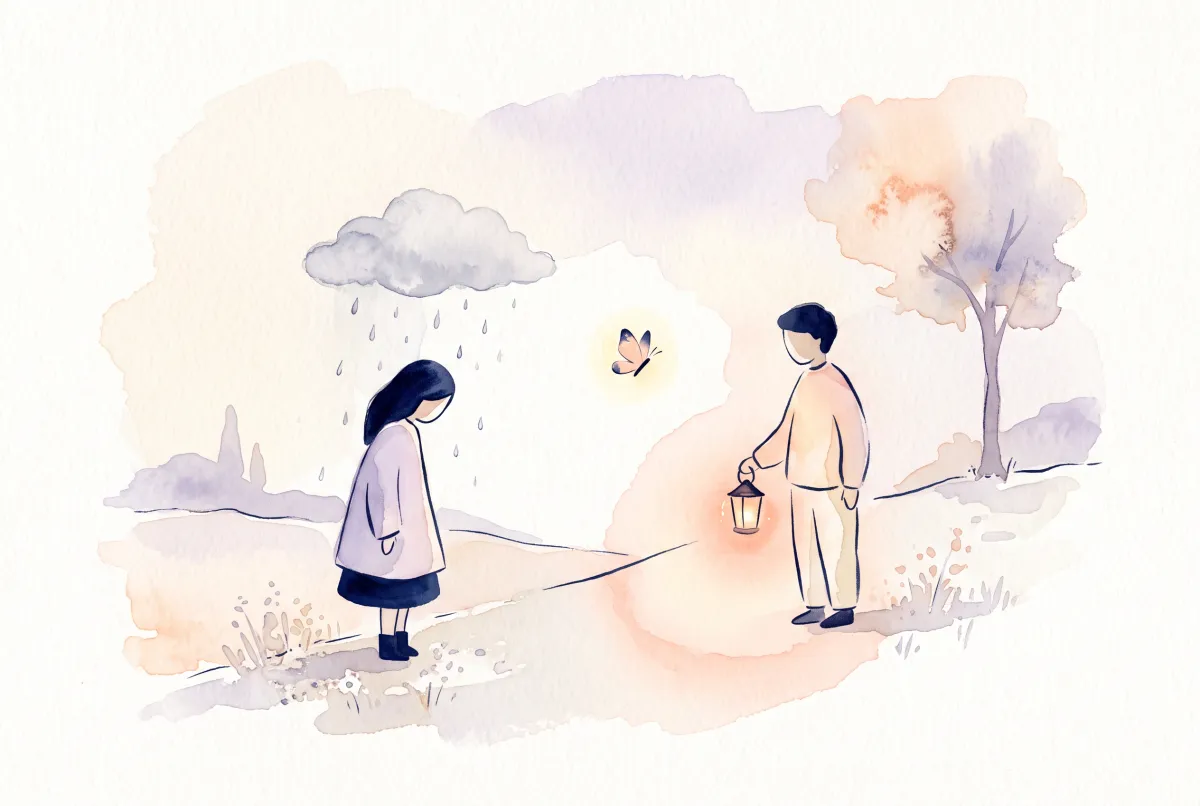
A friend called upset. A coworker vented for twenty minutes. Your mother used a certain tone. The conversation ended hours ago and you are somehow still inside it, tense and flat and vaguely guilty, wondering why something that happened in someone else's life is now sitting in your chest.
Most people land on one of two explanations. Either they are too sensitive, or they care too much. Both explanations point at the same solution, which is to feel a little less, and that solution quietly costs you the people you were trying to be good to.
There is a third explanation, and it is more useful than either of those.
What you are calling too much empathy is usually something else
Researchers who study this draw a line that most of us were never taught.
In a Current Biology primer, Singer and Klimecki describe empathy as feeling with another person while still knowing the feeling started with them, and reserve a different term, emotion contagion, for what happens when that self and other distinction drops away. They note that contagion is the earlier of the two, present in babies well before anything we would call empathy.
This is a conceptual review rather than an experiment, so treat it as a useful map and not a measurement. But the map explains something a lot of caring people get wrong about themselves. What you have been calling too much empathy may not be an excess of anything. It is closeness without a handrail. You went in to feel with someone and lost the thread of where they ended and you began.
That reframe matters because the two problems have opposite solutions. If the problem is caring too much, the fix is to care less. If the problem is a missing distinction, the fix is to keep caring exactly as much and get better at holding the line.
Catch the moment you go from with them to as them
There is a specific hinge where this happens, and you can learn to feel it.
Listen to the sentence running underneath your listening. Sometimes it sounds like she is frightened about this. Sometimes it slides into if this happened to me. The second one feels like deeper empathy. It is usually the moment you stop being any use.
That instinct has been studied directly. In a lab experiment, participants watched video of patients' faces showing pain while being told either to imagine how the patient felt or to imagine themselves in the patient's situation. The researchers found that these perspective instructions changed how participants responded emotionally, alongside differences in brain activity, and framed the results as evidence that our response to another person's pain can be shaped by how we are thinking about it. This was a controlled study with a very specific task, so hold the details loosely. What is worth taking is the direction. The angle you take on someone else's difficulty is not fixed, and it changes what happens in you.
In practice this is one question, asked early. Am I imagining their situation, or auditioning it as mine. If you have started auditioning, come back with something simple and factual. This is her week. I am here for it.
Name your own weather before you step into theirs
You cannot tell whose feeling you are holding if you never checked what you brought in the door.
Take ten seconds before a hard conversation, or in the middle of one if you missed the start. Name your own state in a word or two. Wired. Sad about something unrelated. Hungry and short. Then name theirs separately. He sounds humiliated. She sounds scared, not angry. The point is not accuracy. The point is that the two lists exist as two lists.
Putting feelings into words appears to do real work on its own. In a lab imaging study, labeling emotions was associated with a reduced response in the amygdala compared with other ways of processing the same images, along with more activity in a prefrontal region. That was a controlled setting with images rather than a difficult phone call from your brother, so the effect in real life is likely smaller and messier. Still, most people find that the unnamed feeling is the one that runs the evening.
Trade feeling with them for caring for them
Here is the shift that changes the most, and it is not distance.
In a laboratory training study, participants who were trained in empathic resonance while watching videos of human suffering reported more negative feeling afterward, with increased activity in brain regions previously linked to empathy for pain. When the same participants were then trained in compassion, the increase in negative feeling reversed and reports of positive feeling went up, with activity in a different, non overlapping set of regions. The researchers concluded that compassion training may be a way to counter empathic distress. This was a laboratory study with structured meditation training, so it is a promising direction rather than a proven prescription for a hard Tuesday.
The everyday translation is a change in the sentence you are holding. Feeling with sounds like this is awful, this is so awful. Caring for sounds like I want things to get easier for him, and I am going to stay right here while they are not. The first one sinks with them. The second one stays warm, stays present, and is somehow far easier to sustain for an hour.
You are not becoming detached. You are moving from drowning alongside someone to standing beside them on solid ground, which is the only position from which you can actually hand them anything.
Use the physical exits, without leaving
Some of this is not psychological at all, it is a body that stayed in fight mode after the call ended.
Give hard conversations an ending your body can register. Walk to the end of the street. Wash your hands slowly with attention on the water. Change your shirt. Sit in the car for two minutes before driving, not scrolling, just sitting. These sound almost too small to matter, and they work because they are a signal rather than a solution. The conversation is over. You are here now.
Sleep and food belong in this list too, unglamorously. Nearly everyone finds other people's emotions more porous when they are tired. Absorbing is not always a boundary problem. Sometimes it is a Wednesday problem.
Say the true thing rather than quietly going away
When people feel flooded by someone they love, the usual fix is to become slightly less available. Shorter replies. Later responses. A phone in hand during the story.
The person on the other end feels every bit of that, and because it is never explained, they file it under something worse than the truth. They decide they are too much.
Say the real version instead. I want to hear this properly, and I have about twenty good minutes in me right now, can we start and pick it up tomorrow. Or, I am carrying something heavy today, so if I go quiet it is not about you. Or the simplest one, I do not have advice, I am just going to stay on the phone.
Stated limits keep people close. Unstated ones push them away while looking like nothing happened.
How Murror helps you stay close without going under
Most of the difficulty here happens in the hours after, when the feeling is still in you and you have no idea which parts of it are even yours.
Murror is a place to open up about exactly that. You bring what happened, that your sister called in tears again, that you feel guilty for dreading the phone, that you cannot tell where her fear stops and yours starts, and a caring AI helps you understand what you are actually feeling and what might be true for her. Sorting your own weather from theirs is most of the work, and it is much easier out loud than in your head at midnight.
From there, Murror gently surfaces insights about the people in your life and small, low pressure ways to show up for them, through features like Moments to Care and your Connections, so caring for someone stops depending on how much you happen to be carrying that week. If it helps, something you have worked through privately can become a takeaway you choose to share with the person it is about. Everything stays encrypted and private by default.
Murror is not therapy and it is not a stand in for the people you love. It is a quiet place to understand yourself and them a little better, so you can stay close without going under.
Steady is its own kind of love
You do not have to feel less to stop being flattened by other people's weeks.
Notice the hinge where with them becomes as them. Name your own state and theirs as two separate things. Move the sentence in your head from this is awful to I want this to get better for you. Let your body know the conversation ended. Say your limits instead of silently enacting them.
None of that makes you colder. It makes you the person who is still there in month two, when the crowd has thinned and the feeling has not, standing on ground firm enough to hold out a hand.
Frequently asked questions
Does absorbing other people's emotions mean I am an empath?
It more likely means you are close to someone and paying attention, which is not a personality type so much as a skill you learned. Researchers who study this describe a difference between feeling with someone while still knowing the feeling started with them, and losing track of that line entirely. The second one is what most people mean by absorbing. The good news in that framing is that it is not a fixed trait you were born with and have to manage forever. It is a distinction you can practice noticing, usually in the first minute of a hard conversation, and it tends to get easier the more deliberately you do it.
How do I stop absorbing my partner's stress without seeming cold?
Say the quiet part out loud instead of managing it silently. Most people try to solve this by going a little further away, answering with fewer words, staying on their phone, and their partner feels the distance without being told what it is. Try naming it plainly instead. I want to hear about this, I am running low today, can we do twenty real minutes now and the rest tomorrow. That sounds less warm in your head than it lands out loud, because what your partner actually hears is that you are still coming back. Steadiness that is explained does not read as coldness.
What if the person is family and I cannot create distance?
Then the work moves inward, because the exits are smaller. Notice which sentence you are running in your head during the call. If it is some version of this is happening to me, you have crossed over into their weather. Bring it back to they are having a hard time, and I am here. Build a small ending ritual for after the call, something physical like a walk to the corner or washing your hands slowly, so your body gets a signal that the conversation is over. And keep the length of contact somewhere you can sustain, since a shorter call you are fully present for is worth more to both of you than a long one you spend bracing.