
How to Connect With Your Grandparents
Updated 2026-09-09
You call on Sunday. How are you doing. Fine, fine, everything is fine, and you. Are you eating enough. How is work. It lasts four minutes, you both say I love you, and you hang up having learned nothing at all.
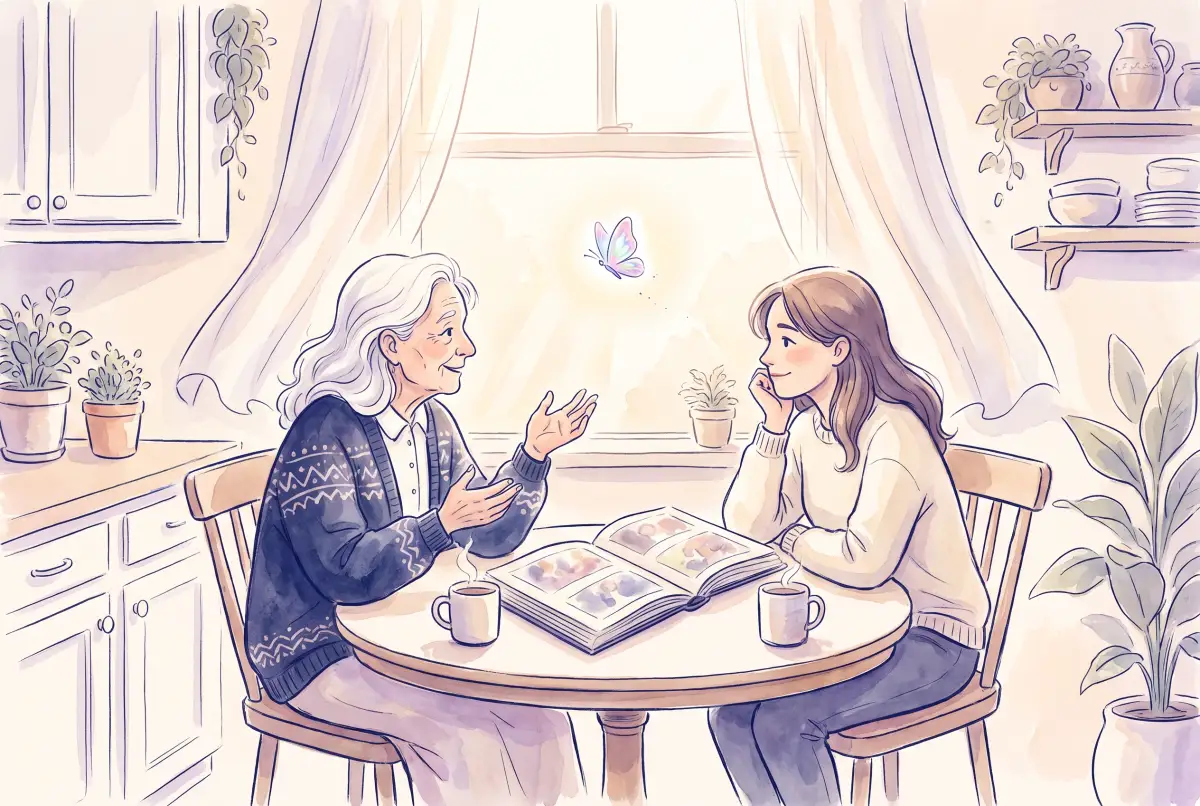
It is not that you do not care. You called, which is more than a lot of people manage. It is that the call has a script, and the script was built to be safe rather than close.
The strange result is that you can speak to someone every week for a decade and still not know what they were afraid of at twenty five, or who they were before they became somebody's grandparent.
The script is doing exactly what it was designed to do
Most conversations with grandparents run on a fixed loop. Health, weather, whether you are eating, how work is going, a brief report on a cousin. Both sides know their lines and neither has to risk anything.
The loop is not laziness. It is politeness running in both directions at once. They do not want to be a burden, so the honest answer gets compressed into fine. You do not want to intrude on whatever fine is covering, so you accept it and move to the weather. Everyone behaves considerately, and the considerate behaviour is precisely what keeps you strangers.
So the useful move is not calling more often. It is asking something the script has no answer prepared for.
Closeness matters more than how often you call
This is worth sitting with, because it cuts against the guilt most people carry about grandparents, which is almost always guilt about frequency.
Researchers followed 374 grandparents and 356 adult grandchildren across seven waves of a long running study of American families between 1985 and 2004. Greater affinity, meaning emotional closeness between the two people, was associated with fewer depressive symptoms for both generations. More frequent contact, on its own, was associated with more symptoms.
This is observational research, so it cannot tell us what causes what, and contact and strain can drive each other in both directions. But the pattern is a useful corrective. Calling more is not automatically the ingredient. A weekly obligation call that neither person enjoys is not a small dose of closeness, and treating it as the goal can leave you doing something faithfully for years that does not build what you want.
The same study found something else worth knowing. For grandparents specifically, receiving practical support without also giving any was associated with more depressive symptoms. Being helped, and only helped, appears to cost something.
Ask about the years you were not alive for
Here is where the real material is. Your grandparents had a whole life before they became the person who sends you money on your birthday, and almost nobody asks about it.
The trick is to ask about a specific time rather than a general topic. What was life like back then is unanswerable, so it gets an unanswerable reply. A narrow question gets a story.
- "What were you like at my age?" Nearly always surprising, because the answer is usually a person unlike the one you know.
- "How did you and Grandma actually meet? Not the short version." The family has an official version, sanded down by retelling. There is a longer one underneath it.
- "What did a Saturday look like when you were seventeen?" Specific, sensory, and it does not require them to decide what was important.
- "Who was your best friend growing up, and what happened to them?" This one opens more than it looks like it will.
- "What did you worry about when you were raising Dad?" It reframes your own parent as someone's kid, which is good for everyone in the family to hear out loud.
- "What do you wish someone had told you at twenty five?" People love being asked for this, and they rarely get to give it.
One question is plenty. This is a conversation, not an oral history project, and the goal is that they enjoy it.
The follow up matters more than the question
Whatever you ask, the second question is the one that does the work.
Across three studies of live conversations between pairs of people, researchers found that people who asked more questions, and follow up questions in particular, were better liked by the person they were talking to. Asking more was linked to being seen as more responsive, meaning the other person felt listened to and understood. Those studies were lab conversations and speed dating, not phone calls with grandparents, so read it as a general pattern in how conversation works rather than a finding about families. It still points somewhere useful.
A follow up is the proof that you were actually listening, rather than waiting to deliver your next prepared item. And it is never clever. And then what happened. Were you scared. What did she say back. Did your parents know.
Listening counts as doing something
There is a persistent feeling that a visit needs a task, and that just sitting and hearing about 1962 is not really contributing anything.
In a registered study where one group was trained to listen well while their partner talked, high quality listening predicted more positivity resonance, a warm shared feeling reported by both people, not just the one being heard. Other measures the researchers looked at, including how authentic people felt, did not shift. The authors describe these as early findings that need further study, so hold it loosely. Modest is the honest word here.
In practice it mostly comes down to unglamorous things. Put the phone face down. Let silences run longer than feels comfortable, because many older people take a beat before answering and will be talked over by anyone who does not wait. Do not correct the dates. If they have told you this story four times, the retelling is not a mistake, it is what they have chosen to hand you.
Let them give you something
This is the part most well meaning grandchildren get backwards, and the research above hints at why.
We tend to arrive in helper mode: fixing the printer, carrying things, doing the good deed and leaving. All of it kind, all of it one directional, and it quietly casts them as the person things are done to.
So ask them to teach you something instead. The recipe, written down while they walk you through it. How to prune the tree properly. Ask advice about something real in your life and take it seriously in front of them. Being useful to someone you love is a form of dignity, and it is the easiest thing in the world to accidentally take away.
When it is harder than this
Not every version of this is a sunny kitchen table.
If there is history. Distance and old hurt do not have to be resolved before you can be curious. Aim lower than reconciliation. One question, no agenda.
If you do not share a language well. Ask simpler questions and accept slower answers. Bring a parent who can bridge it, or sit with photos, which carry a lot of conversation without much vocabulary.
If their memory has changed. Follow them into whichever year they are in rather than quizzing them about this one. Correcting people about the present tends to produce distress without producing accuracy. The relationship can still be warm inside their version of events.
If they are far away. A voice note with one specific question in it often gets a better answer than a scheduled call, because they can reply when they have the energy.
Using Murror for this
Often the thing standing between you and the call is not indifference. It is something tender that you have not looked at directly: guilt about the months you did not phone, awkwardness left over from your family's way of not discussing feelings, or a quiet anticipatory grief about how much time is left.
That is what Murror is for. You open up to a caring AI that helps you understand what you are actually feeling, and helps you think about the person you care about, including what you would genuinely like to know about them before you cannot ask. In a meta-analysis of 146 randomized studies of expressive disclosure, putting difficult experiences into words showed a positive but modest average effect. Modest is the accurate word. Getting clear helps somewhat and reliably, which is a different thing from making the call for you.
Over time Murror surfaces gentle insights about your relationships. When someone keeps appearing in what you write, that usually means they matter more than your calendar suggests, and Murror offers small, low pressure ways to show up for them through Moments to Care and Connections. For a grandparent that might be a nudge toward one question you have been meaning to ask, or a reminder that it has been a while and a short call would land well.
And if something you work out privately turns out to be worth saying to them, you can turn that reflection into an optional takeaway to share. Nothing leaves unless you choose to send it, and everything stays encrypted and private by default.
Murror is not therapy, and it is not a replacement for the people in your life. It is a place to get clear enough to go back to them with a better question.
Start with one question this week
You do not need a project. Recording their life story is a lovely idea that mostly does not happen, because it is large and can always be started later.
You need one question, asked on the next ordinary call, that they have never been asked by you before. Then a follow up. Then enough quiet for the real answer to arrive.
Years from now you will not remember the Sundays where you both said everything was fine. You will remember the afternoon they told you about the boat, or the friend, or the thing they never told anyone. That afternoon only exists if somebody asks.
Frequently asked questions
What if my grandparent barely talks?
Try changing what you are asking rather than how hard you are trying. Quiet people are often not withholding, they just have nothing to say to a question like how have you been, which asks them to summarize an entire life since Tuesday. Small and specific works better: what did you have for lunch, what is that tree outside the window, what were Saturdays like when you were seventeen. Doing something side by side helps too, because it removes the pressure to fill silence. Cooking, sorting photos, a short walk, a drive. A lot of people who seem quiet across a table talk freely once their hands are busy and nobody is watching them do it.
We do not really have anything in common. What do I even talk about?
You have more overlap than the surface suggests, it is just buried under sixty years of different circumstances. You have both been young and uncertain about what to do with your life. You have both loved someone and worried about them. You have both had a job you disliked and a friend you lost touch with. Those are the veins worth mining, and they are also the ones nobody asks about. Skip current events and shared hobbies, which is where these conversations usually go to stall, and ask about a time in their life instead of a topic. Time travels better than opinions.
Is it too late if we were never close to begin with?
It is not too late, but it helps to lower what you are asking for. Trying to jump straight to closeness with someone you have always been formal with tends to make both of you self conscious, and it can read as though something is wrong or someone is sick. Aim for interested rather than intimate. One real question per visit, no follow up expected, no big talk about the relationship. Closeness built this way arrives sideways and takes months, which sounds slow until you compare it with the alternative of waiting for a moment that feels right and never getting one.