
How to Deal With Homesickness and Feel Less Alone
Updated 2026-11-21
The move is done. The boxes are mostly unpacked, the new keys are on the hook, and everyone back home thinks you are doing great. Then a certain song comes on, or you smell something that almost matches the cooking you grew up with, or it is simply Sunday evening, and your chest goes tight. Maybe you chose this move, or maybe you had to leave. Either way you just want, for a moment, to be somewhere that already knows you.
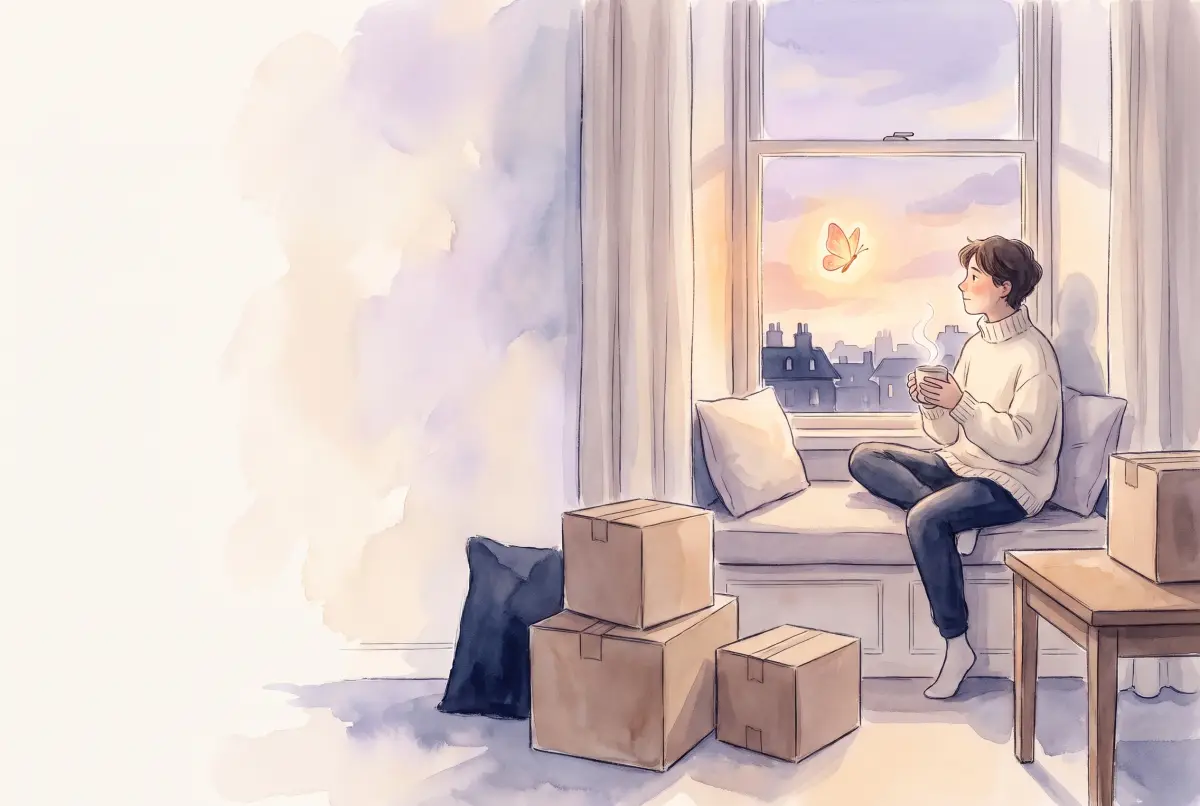
That is homesickness, and it is one of the most ordinary kinds of loneliness there is. This guide is for anyone who has moved for school, work, love, safety or a fresh start and is missing home more than they expected. A note before we begin: "home" is not a warm word for everyone. If the place you left was painful or unsafe, the ideas here about staying in touch may not fit, and you do not owe anyone contact. There is a section further down for you.
Homesickness is missing, not weakness
It can feel childish to be an adult who is homesick. It is not. A theoretical model by Stroebe, Schut and Nauta proposes thinking of homesickness as a response to separation, a kind of "mini-grief". In our words: a small, real loss of daily closeness, whether the move was your own good choice or something you had to do.
Seen that way, the ache says something kind about you. You had people who knew your routines, places that asked nothing of you, and a version of yourself that fit there easily. Of course you feel the gap.
It also explains why homesickness can sit right next to excitement. You can love your new job and cry in the grocery store because they do not sell the right brand of tea. Both are true. Neither cancels the other.
It is common, and on average it eased slightly
If you feel like the only one struggling while everyone else settles in, the research is gentle on that worry. In a study that followed first-year college students weekly through their first term, English, Davis, Wei and Gross (2017) described homesickness as a common experience. On average it decreased slightly over the term, although people differed in how it changed over time.
Two details from that study are worth holding onto. Students who reported more homesickness also tended to report a harder time adjusting, and the social difficulties were limited to their interactions with others at college. The study was of college students and it shows links, not causes, so it cannot say what will happen for you. Still, it fits something many people recognize: when you are aching for home, it may be harder to lean toward the people right in front of you.
So if making friends here has felt strangely hard, it may not be that something is wrong with you or with them. One possibility is that part of you is still facing the other way.
Two things at once: miss home, and build here
A lot of advice about homesickness boils down to "stay busy and it will pass." Distraction can help on a rough evening. But the same model from Stroebe and colleagues proposes that the missing and the adjusting are two different things, and that support should pay attention to missing home, not only to distraction and settling in.
Our suggestion, not a research finding, is to think of it as moving back and forth:
- Time for missing. Look at the photos. Cook the dish. Tell someone, "I miss home today." Let it be a feeling instead of a problem to fix.
- Time for here. Learn one street. Say yes to one small invitation. Find the bakery, the bench, the bus route that will become yours.
Neither one is a betrayal of the other. Missing home does not mean you are failing to settle, and settling does not mean you are forgetting where you came from.
Stay in touch in ways that leave you warmer
If contact with home is unsafe, painful or unwanted, skip this section. You do not owe anyone a call. For everyone else, contact with home can be a comfort, and sometimes it stings. In a study in which 92 first-year students reported on their social interactions over two weeks, Nauta and colleagues (2020) found that homesick feelings tended to be highest when students were at their current residence, when they were interacting with parents, or when they were using video chat. That does not show that contact with home causes homesickness. The feeling was also high simply at their residence, and people may reach for home when it is already strong. It does suggest that calls can be tender moments, so it is worth noticing how different kinds of contact land for you.
A few gentle experiments:
- Notice the aftertaste. After a call, do you feel held or hollow? A short voice note during the day might warm you more than a long video call alone in your room at night, or the other way around.
- Tell the truth, lightly. "I am fine" keeps the people who love you at a distance. Try, "I am doing okay, and I miss you all more than I thought I would."
- Ask about their ordinary days. Homesickness can make calls all about your absence. Asking what a friend had for lunch or how your dad's knee is doing lets you stay part of their everyday life.
- Let them see your new world. Show them your street, your desk, the view from the bus. It helps the people at home picture you somewhere real.
Feeling accepted is linked to less homesickness
It is easy to measure settling in by how many friends you have made. In two studies of homesickness and the need to belong, Watt and Badger (2009) found that people who felt accepted in their new community reported less homesickness, and that this link held regardless of how many friends they had.
That takes some pressure off. You may not need a full circle by next month. One suggestion, not a research finding: aim for a few places where you are recognized and welcome.
- Become a regular somewhere. The same cafe, class, gym hour, library table or place of worship each week. Familiar faces can be a gentle first step.
- Accept small welcomes. When a neighbor says hello or a coworker asks you to lunch, let it count, even if it is not deep yet.
- Share something from home. Bring the snack, play the song, teach someone the word. Letting people meet where you come from can make you feel less split in two.
- Look for someone newer than you. Offering one small welcome to another newcomer is a quiet way of belonging.
When home is complicated, or the feeling is heavier
Not everyone misses a happy home. You might have left a place that hurt you and still ache for the food, the weather, the language, or one person. You might be unable to go back at all. That mix of relief and longing is common, and it does not mean you made the wrong choice or that the hard parts were okay. You can miss pieces of a place without owing it your return. And if someone controls who you can talk to, or you feel cut off from people you love, please tell someone safe.
Homesickness can also grow into something heavier. If the sadness stays most days for weeks, if you are barely sleeping or eating, or if you find yourself pulling away from everyone, please reach out to a doctor, a counselor or someone you trust. Needing more support than an article can give is not a weakness. It is information.
How Murror helps you feel closer, here and there
Murror is a space to practice empathy, including toward yourself on the days you miss home. You can open up to a caring AI companion about what the move is bringing up, and it can help you put words to what you are really missing, whether that is a person, a routine, or the feeling of being known.
From there, Murror gently surfaces insights about your relationships and small, low-pressure ways to show up for people, like a Moment to Care that nudges you to check in, if you want to, with someone who feels safe and has been on your mind, or a Connection that helps you remember what matters to a person you love. When a private reflection turns into something you want to say, you can make it an optional takeaway to share with someone you trust. Everything stays encrypted and private by default. Murror is a companion and a bridge back to people, never a replacement for them, and never therapy.
One small thing to try this week
Pick one from each side. If there is someone back home who is safe for you, you could send one honest message, something like, "Thinking of you today. I miss our Sunday dinners." Then do one small thing that roots you here: say hello to the same barista twice, or walk a street you have not walked yet.
You do not have to stop missing home in order to belong somewhere new. It is okay to carry both: the place that made you, and the one you are getting to know.
Frequently asked questions
How long does homesickness last?
There is no set timeline, and it is different for everyone. In one study that followed first-year college students week by week, homesickness eased slightly over the first term on average, but people differed in how it changed. If it stays heavy for many weeks, or makes it hard to eat, sleep, work or study, it is worth talking to someone you trust or a professional. That is not a failure. It is a way of getting support.
Does calling home make homesickness worse?
If contact with home is not safe or not wanted, you can skip it, and that is okay. Otherwise, not necessarily. In one small study, students tended to report feeling more homesick when they were at their current residence, when interacting with parents, or when using video chat, but that does not show the contact caused it. People may simply reach for home when they already miss it. A more useful question is how you feel afterward. Keep the kinds of contact that leave you warmer, and gently adjust the ones that leave you emptier.
Is it normal to feel homesick as an adult?
Yes. Homesickness is not only for children at camp or students in their first year. Adults feel it after moving for work, for a partner, for safety, or to another country, and it can return years later around holidays or hard days. Missing people and places you love is not immaturity. It is a sign that something mattered to you.
Why do I miss a home that was not good for me?
You do not have to go back, or get back in touch with anyone, to make sense of this feeling. It is common to miss familiar streets, food, a language, or the person you were there, even when home was painful or unsafe. Missing parts of a place does not mean the hard parts were okay. If this brings up a lot, a counselor or someone you trust can help you hold both.