
How to Get Along With Your Partner's Friends
Updated 2026-10-21
You are about to walk into a room where everyone knows each other, everyone knows your partner, and the only person they are still figuring out is you. Maybe you have rehearsed three things to say. Maybe you have already decided what to wear, what to drink, and how long you can stay without seeming rude. If your stomach tightens at the thought of meeting your partner's friends, that is a very human response, and it says something kind about you: you care about being welcomed by the people your partner loves.
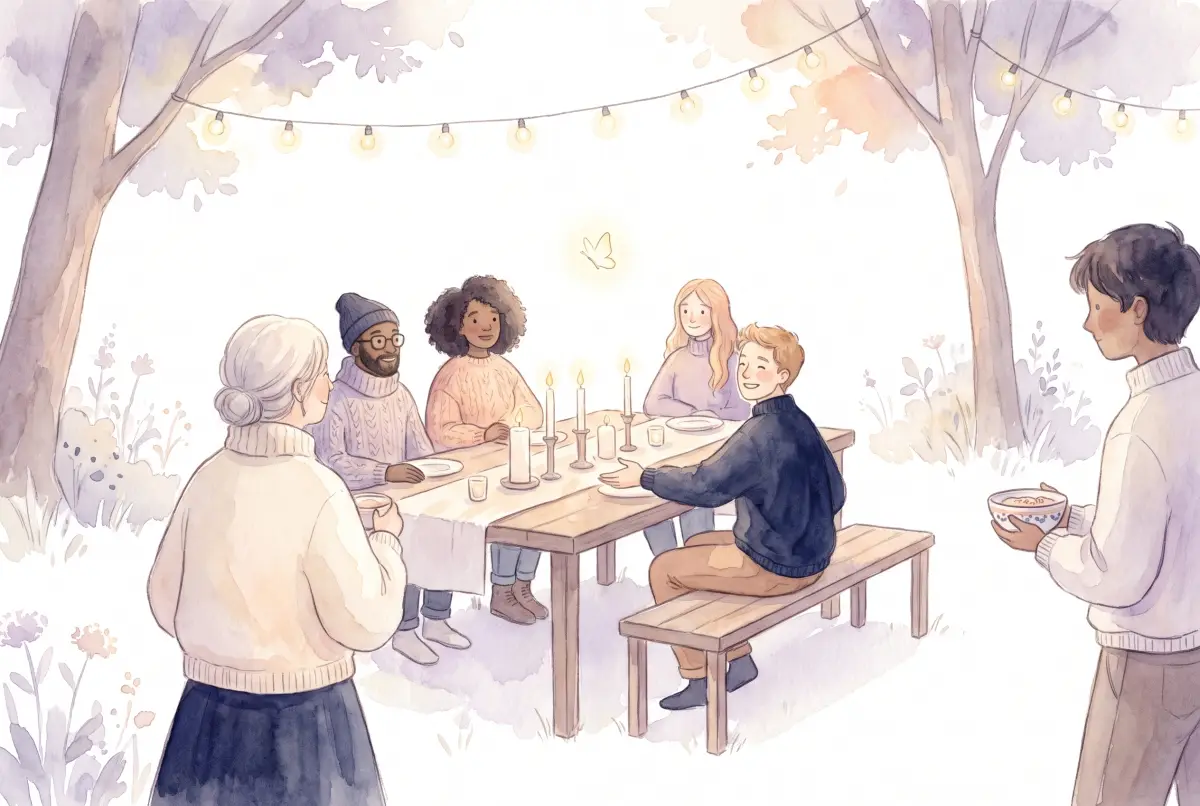
Getting along with your partner's friends is less about being impressive and more about being easy to be around. This article looks at why these first meetings feel so loaded, what research on first impressions suggests, and a handful of small, low-pressure ways to go from "the new person" to someone they are glad to see.
Why it feels like an audition
Belonging is not a small thing for people. In a classic review, Baumeister and Leary (1995) argued that humans have a fundamental need to form and keep close relationships, and that threats to belonging are linked to strong emotional reactions. Walking into an established group puts that need on the table. You are the one who has to be accepted.
There is also a practical reason your partner's friends matter to you. In a survey of 858 married couples, Bradford and colleagues (2020) found that perceived disapproval of the relationship from friends and parents was linked to how people rated their relationship quality, and that how securely partners behaved toward each other changed how strong that link was. This is correlational, in one sample of married couples, so it does not mean that a cool first dinner dooms anything. It does suggest why the stakes feel high even when no one says so.
You can hold both truths at once. The pressure is real, and it is usually much louder in your head than in the room.
They are probably noticing you less than you think
Two findings can take some weight off your shoulders.
The first is the spotlight effect. In a series of studies, Gilovich, Medvec and Savitsky (2000) found that people overestimated how much others noticed their actions and appearance, including, in a group discussion, how prominent their own comments were. That was in lab settings, but it matches a familiar feeling: you replay the awkward joke for days while everyone else has already moved on to the next topic.
The second is the liking gap. Boothby, Cooney, Sandstrom and Clark (2018) studied conversations between people meeting for the first time, in the lab, among college dorm mates, and in a workshop. After talking, people systematically underestimated how much their partners liked them and enjoyed their company, and the gap persisted for months among the dorm mates. In other words, the quiet worry that "they didn't warm to me" may be a miscalculation we tend to make, not a fact.
Neither study is about partners' friends specifically, and neither guarantees anything about your particular group. But they give you a fair reason to treat your own inner critic with some skepticism after a first meeting.
Be curious, and ask a follow-up
If you only change one thing, change your questions. In three studies of live conversations, Huang, Yeomans, Brooks, Minson and Gino (2017) found that people who asked more questions, particularly follow-up questions, were better liked by their conversation partners, and that people told to ask more were seen as more responsive, meaning more attentive and caring. This was mostly in get-to-know-you chats, so it is a good fit for early meetings with a new group.
A follow-up question is simply the next question, built from what the person just said:
- "You mentioned that trip. What was the best part?"
- "How did the two of you end up becoming friends?"
- "What is your partner like when you are all together?"
That last one is a gift. Friends often love telling you who your partner was at nineteen. It makes you feel closer to your partner, and it tells the friend that you care about the same person they do.
Try for one real follow-up per conversation, not an interview. If you notice you are asking questions to avoid being seen, let one go and share a small true thing about yourself instead. Warmth runs in both directions.
Let their history stay theirs
Inside jokes, old stories and shorthand can make you feel like you are watching a movie in the middle. Try not to read that as a message about you. Long friendships build their own language, and they usually do not notice they are speaking it.
You do not have to pretend you understand. Laugh if it is funny, then ask, "Okay, I need the full story." Most people are delighted to tell it, and you have just turned a wall into a door.
It also helps to resist the urge to compete with the past. You do not need to prove you are as important as someone who has known your partner for fifteen years. You are a different chapter, not a replacement for theirs. If a pang of jealousy shows up, you can notice it, name it quietly to yourself, and let it pass without acting on it.
Do not make your partner the referee
It is tempting to turn to your partner mid-evening and whisper, "Do they like me?" Or to debrief the whole night in the car, sorting each comment into good or bad. A little of that is normal. A lot of it can leave your partner stuck between two groups they love, trying to reassure you and defend their friends at once.
Some gentler asks that tend to land better:
- Before the event: "Who will be there, and is there anything about them I should know?"
- At the event: "Can you introduce me with one thing I'm good at or curious about?"
- Afterward: "I felt a bit on the outside tonight. Can I tell you about it for a minute?"
That last one shares a feeling instead of asking for a verdict. Your partner can respond to how you feel, which is something they can actually help with, rather than to a question they cannot answer.
Give it small, repeated contact
Friendships with a partner's friends rarely begin in one big night. They tend to grow from small, repeated, easy moments: a coffee with one friend while your partner is at work, a message about a show you both mentioned, a standing game night where you slowly become part of the furniture.
You do not have to be best friends with everyone. A good goal is to be someone each of them is comfortable having around. Aim for one person at a time. Pick the friend who seemed warmest and find one low-key way to connect, like sending the article you talked about or suggesting a short walk. Warmth tends to compound when it is invited gently and often.
And if you are the one who is hosting, you can do for others what you wish had been done for you. Notice the person standing at the edge of the room, and make space. Our guide to making someone feel included goes deeper on that.
When it is more than awkward
Most of the time, the awkwardness is just newness, and it eases. But a few things are worth taking seriously: if friends are openly unkind to you, if you feel unsafe being yourself with the group, or if your partner discourages you from seeing your own friends or family. Healthy relationships leave room for other people. If any of this sounds familiar, it can help to talk it over with someone you trust outside the relationship, like a close friend, a family member or a counselor.
How Murror helps you meet the people your partner loves
Murror is a space to practice empathy for the people in your life, including the ones you are only beginning to know. Before a gathering, you can open up to a caring AI companion about what you are nervous about, and it helps you understand what you are feeling and see the situation from a few sides, including what your partner's friends might be feeling too.
Over time, Murror gently surfaces insights about your relationships and small, low-pressure ways to show up for people, like a Moment to Care that nudges you to follow up with someone you met, or a Connection that helps you remember what a friend told you matters to them. If you want to say something to your partner about how the evening felt, you can turn a private reflection into an optional takeaway to share with someone you trust. Everything stays encrypted and private by default. Murror is a companion and a bridge back to people, never a replacement for them, and never therapy.
A small start for the next gathering
Pick one thing to carry in with you: a single follow-up question, or one friend you would like to know a little better. You do not need to win the room. You only need to be a little curious and a little kind, and let belonging build at its own pace.
Frequently asked questions
What if my partner's friends don't seem to like me?
Give it more time before deciding. In studies where strangers chatted and then rated each other, people tended to underestimate how much their conversation partners liked them, and that gap showed up for months among new dorm mates. A quiet first meeting may say more about everyone's nerves than about you. If it still feels cold after a good stretch of small, easy contact, you can tell your partner how it feels without asking them to fix their friends.
Should I ask my partner to make their friends like me?
It usually works better to ask for something smaller, like an introduction that includes a detail about you, or a heads-up about who will be there. Asking your partner to manage their friends can put them in the middle between two groups they love. You are more likely to build real warmth by having a few one-on-one moments with the friends yourself.
How do I handle inside jokes and stories I wasn't there for?
Treat them as an invitation to be curious rather than a wall. You can laugh along, then ask 'wait, what happened?' and let someone tell it. People often love explaining their favorite stories. Over time you build your own shared moments, and the old ones stop feeling like a locked room.
What if my partner seems to want me to stay away from their friends, or from mine?
That is different from ordinary awkwardness. If someone discourages you from seeing friends, makes you feel guilty for having other people, or you feel afraid to be honest, it is worth talking to someone you trust, such as a close friend, a family member or a counselor. Healthy relationships leave room for other people.