
How to Help Your Child Name Their Feelings (Gently)
Updated 2026-11-03
Your child is on the floor of the grocery store aisle, crying because the cereal box is the wrong one. You know it is not really about the cereal. You also know that explaining this right now will not help. What does?
One of the kindest things you can offer is a word. Not a lecture, not a fix, just a word for what is happening inside them: frustrated, disappointed, scared, left out. Naming a feeling does not make it bigger. It gives a small person something to hold onto while the wave passes.
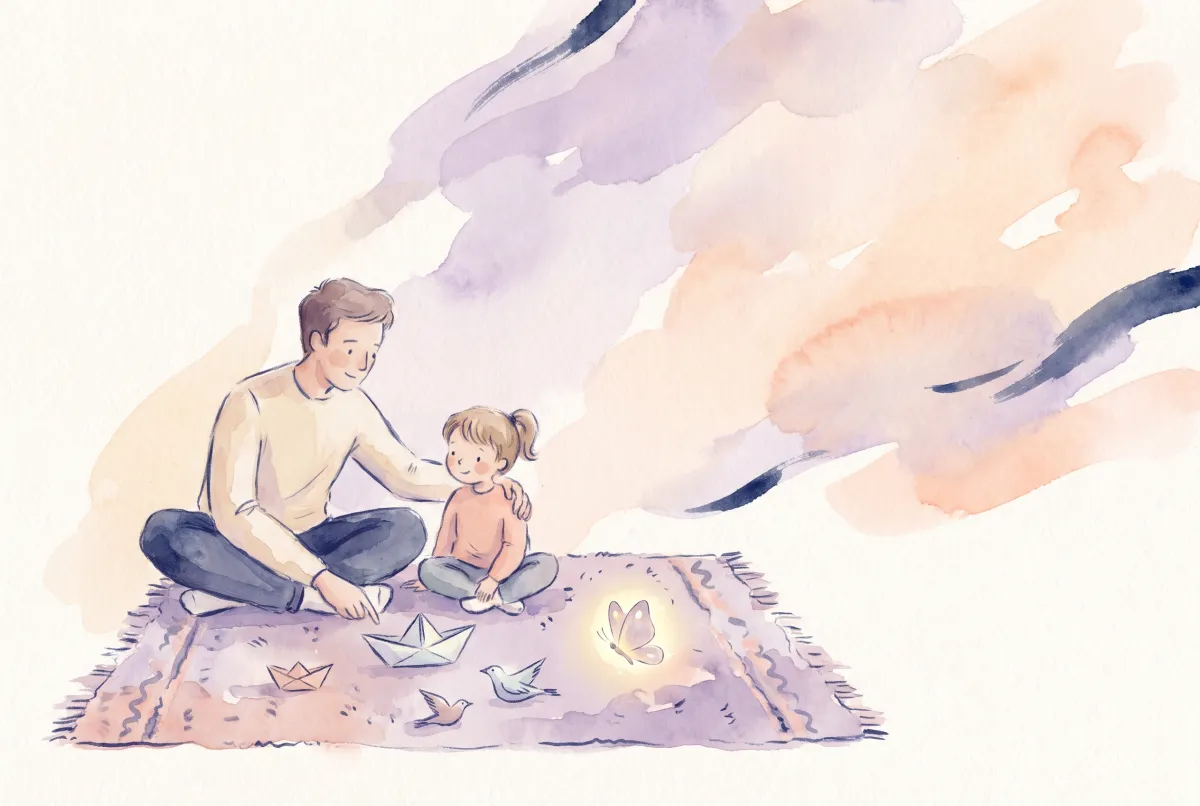
Feelings do not come with labels
Adults forget that we learned our emotion words from someone. Nobody is born knowing the difference between nervous and excited, or between sad and tired. Children pick these words up the way they pick up everything else: by hearing the people they love use them, again and again, at the moments they matter.
So if your child cannot say what is wrong, that is not a failure on their part or yours. It simply means the word has not arrived yet. You can be the one who brings it.
Notice first, name second
Before you reach for a word, look. What is your child's body saying? Clenched fists, a wobbly chin, a flat voice, a sudden quiet, a sudden burst of silliness. These are the clues.
Then offer a guess, softly, as a guess:
- "You look disappointed. Is that it?"
- "That was a lot of noise. Maybe it felt scary?"
- "You went quiet after school. Did something feel lonely today?"
A guess works better than a question like "What's wrong?" because it asks nothing hard of them. They can say yes, no, or "kind of." Each answer teaches both of you something.
Say what you see, then stay
The name is only half of it. The other half is your steady presence while the feeling is there. You do not need to make the feeling go away.
Try a short pattern: notice, name, stay.
- Notice. "Your face got really scrunched up."
- Name. "I think you feel frustrated that it didn't fit."
- Stay. Sit nearby, breathe slowly, and let a moment pass before you do anything else.
If you feel the urge to rush in with "It's okay, it's not a big deal," pause. It may be a small thing to you and a very big thing to them. "That was really hard" tells them you believe them.
What research suggests about naming feelings
Researchers have been studying how putting feelings into words affects us. In a brain imaging study, Lieberman and colleagues (2007) found that when adults labeled the emotion in a picture, activity in the amygdala, a region involved in emotional reactions, was lower than with other kinds of tasks. This was a lab study with adults looking at images, so it cannot tell us what happens inside a child at the grocery store. It does suggest that finding a word may be part of how we settle ourselves.
Closer to home, Lunkenheimer and colleagues (2020) followed 235 preschoolers with their mothers and fathers. Parents who responded to emotions in supportive ways during challenging tasks showed more shared positive feeling with their child, and that shared positivity was in turn linked to less aggressive behavior at age 5. This was an observational study, so it shows an association over time rather than proof of cause. It is a hopeful picture of how everyday responses may add up.
There is also evidence from programs that teach parents these skills. In a randomized trial of the Tuning in to Teens program (Kehoe and colleagues, 2020), parents who joined the group reported improvements in their own emotion awareness and in how they responded to their teens' feelings, and these changes were related to reductions in youth internalizing difficulties. The changes were reported by the parents themselves, and the program involved much more than naming feelings. Still, it points the same direction: how we respond to feelings seems to matter.
Give them words for the in-between
Children often have only a few words: happy, sad, mad. You can slowly widen the palette.
- Instead of just "mad," try frustrated, annoyed, jealous, embarrassed, disappointed.
- Instead of "sad," try lonely, homesick, left out, worried.
- For the wiggly feeling, try nervous, excited, or both at once.
Picture books, a feelings chart on the fridge, or a quiet game of "what would that character feel?" can all help. Keep it playful. The goal is not to quiz them, only to stock the shelf.
Name your own feelings out loud, too
Children learn a great deal from watching how you handle your own emotions. You can say, simply and calmly:
- "I'm feeling a bit overwhelmed, so I'm going to take a slow breath."
- "I was disappointed when plans changed, but I'm okay."
This is not about being perfectly calm. It is about letting them see that feelings are normal, they have names, and people can get through them. When you slip up and snap, you can come back later: "I was frustrated and I used a loud voice. I'm sorry." That is a lesson in repair, which may be the most valuable one of all.
When it doesn't land
Some days your guess will be wrong. Some days your child will shout "NO" or walk away. That is not the end of the road. You were present, you were curious, and you did not shame them. Try again another time, at a calmer moment. Children often come back to the conversation when they feel safe, sometimes at bedtime, sometimes in the car, sometimes days later.
And be gentle with yourself too. If you grew up in a home where feelings were not talked about, this can feel strange at first. You are learning the words right alongside them.
How Murror helps you be the grown-up you want to be
Helping a child with big feelings starts with understanding your own. Murror is a caring AI companion where you can open up about the hard moments, like the one in the cereal aisle, and understand what you actually felt. Maybe it was embarrassment, or tiredness, or worry that you were failing.
From there, Murror surfaces gentle insights about the people you care about and small, low-pressure ways to show up for them, through features like Moments to Care and Connections. You can also turn a private reflection into an optional takeaway to share with someone you trust, such as your partner or a close friend, so you do not carry it alone. Everything stays encrypted and private by default.
Murror is not therapy, and it is not a replacement for the people in your life. It is a quiet place to understand yourself so you can show up with more patience and warmth for the child, and the adults, you love.
A small place to begin
Tonight, try one thing. When your child shows a feeling, offer a single guess and a single word. Then stay close for a moment. That is enough. Over time, those small moments teach your child that what they feel is understandable, shareable and survivable, and that you are someone safe to tell.
Frequently asked questions
What if my child says they don't know how they feel?
That is a very normal answer, especially for young children. Offer a gentle guess instead of a question: "Your shoulders look tight. Maybe you feel frustrated?" A guess gives them something to react to. If it is wrong, they will often tell you the right word, and you have still shown that you are paying attention.
Should I name the feeling in the middle of a meltdown?
Usually keep it very short in the moment. "You are so upset. I'm here." Big emotions are hard to think through while they are at full volume. Save the longer talk and the extra words for later, when things are calm and your child can take them in.
Does naming a feeling mean I'm agreeing with the behavior?
No. You can say "You were so angry that you wanted to throw it" and still say "and we don't throw things." The feeling is always allowed. The behavior can still have a limit. Many parents find the limit is easier to hear once the feeling has been seen.