
How to Stop Feeling Like a Third Wheel With Friends
Updated 2026-10-30
Two of your friends start a story you were not there for. They laugh before the punchline, finish each other's sentences, and for a moment you are holding your drink and smiling at the right times. Nobody did anything wrong. You still feel like the extra seat at the table.
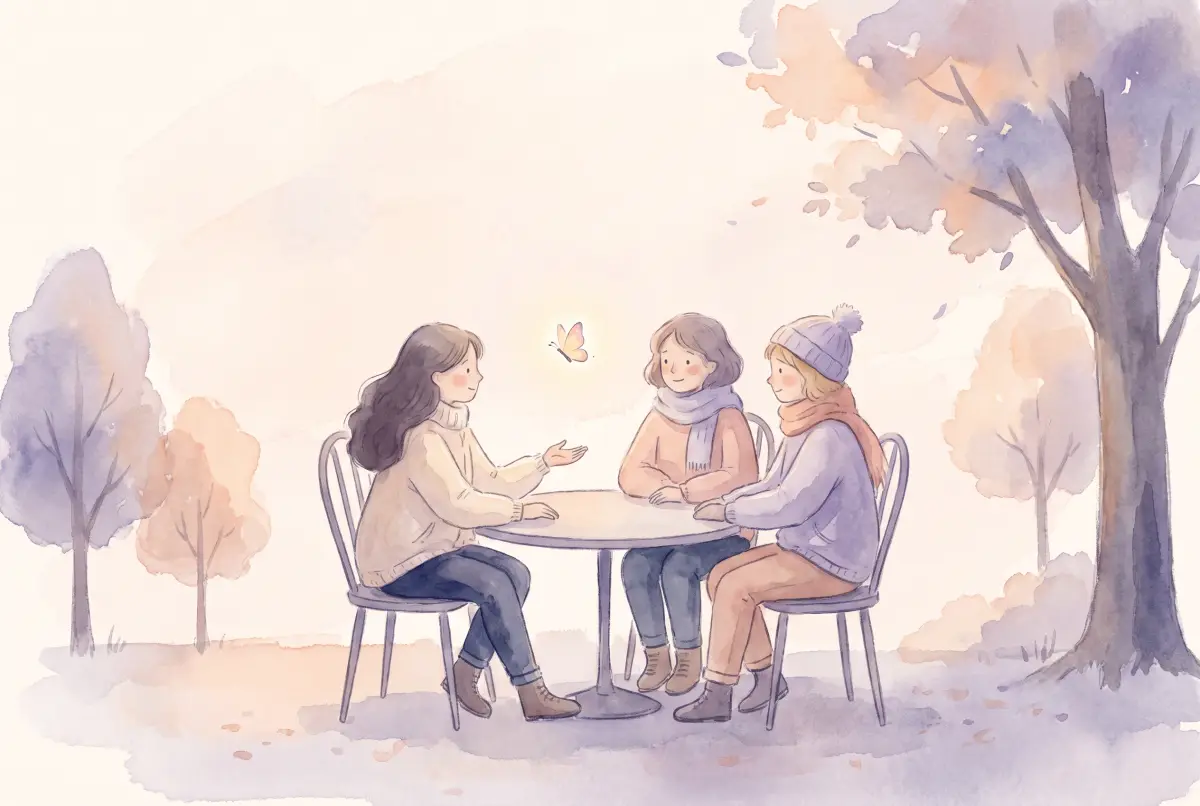
If that is familiar, nothing is wrong with you. Feeling like a third wheel is one of the quieter kinds of loneliness, because it happens in company and nobody else seems to notice. The good news is that it usually has more to do with the shape of the group than with how much you matter, and that shape can change.
A group of three is really three friendships
Three people sound like one group. In practice they are three separate pairs: you and one friend, you and the other, and the two of them. Each pair has its own history, jokes and shorthand. When all three are together, whichever pair has the most shared history tends to set the rhythm, without either of them choosing to.
Closeness is built mostly from time. In two studies of people making new friends, Hall found that more hours spent together was associated with closer friendships, and so was time spent on leisure activities together. The studies were small, relied on people's own estimates of their hours, and were about new friendships, so treat them as a rough guide rather than a formula. But they offer a useful reframe. The ease between those two is probably a pile of hours, not a ranking of who likes whom.
That matters because the story we tell in the moment is usually a ranking. They are closer to each other than to me. A pile of hours is something you can add to. A ranking is something you can only be hurt by.
The sting is real, even when it is small
It can feel silly to be hurt by a conversation you drifted out of. Researchers have noticed how quickly the mind picks up on being outside a circle. In a brain imaging study, Eisenberger and colleagues scanned people playing a virtual ball-tossing game in which they were eventually left out. Being excluded was associated with more activity in a brain region involved in physical pain, and that activity tracked how distressed people said they felt.
It was a small lab study with a computer game, so it cannot tell you what is happening at your friend's dinner. But it fits what many people describe: even a minor, unintended moment of being left out can register, and it is not weak or dramatic to feel it.
Three versions of the same feeling
Before you decide what it means, it helps to sort what you are actually in. Most third-wheel moments are one of these:
An accident of history. The two of them have a backstory, and you are new to it or were not around for it. Nobody is excluding you, the past is just loud.
A pair that forgot to turn around. They are happy together and slid into a two-person conversation without noticing the third. This is common, and it is fixable with a small nudge.
Being kept out on purpose. Inside jokes used as a wall, plans made where you can see them, a pattern of not being asked. This is rarer than it feels in the moment, but it does happen.
Whichever it is, you can start in the same place: you do not have to leave the moment or fake enjoyment to stay in it.
In the moment: ways back into the conversation
You do not need a grand gesture. A few small moves tend to work better than waiting to be rescued.
Ask for the story. "Wait, I need the full version of that." Most people love being asked, and telling the story to you turns a closed loop into a three-way one.
Offer something that is yours. If the talk is about a trip you did not take, add a thread from your own life that touches the topic. You are not competing, you are widening the table.
Change the activity, not the people. Suggest getting food, a walk or a game. Doing something together gives all three of you a shared present, which is easier to join than someone else's past.
Take a short breather without a verdict. Refill your drink, step outside for air. A two-minute reset is better than sitting in a story that you are quietly writing against yourself.
After: build your own hours
The most lasting change usually happens outside the group. If you want to feel less like the extra one, add to the hours you share with each friend separately.
Ask one of them for something small and specific: "Want to get coffee Saturday, just us?" Then ask the other. These are not secret meetings, just ordinary friendship. Hall's findings point toward doing things together, so choose an activity, not only a chat. Over weeks, your pairs get their own shorthand, and the group of three feels less lopsided.
It also helps to know that wanting this is a sign you care. Krems and colleagues ran 11 studies with nearly 3,000 people on friendship jealousy and suggested it is strongly tied to cues that you are being replaced, and sensitive to how much the friendship is valued. The studies used scenarios and recalled events, so hold them lightly. But it offers a kinder way to read the ache: it points at friends who matter to you.
If the feeling is strong enough that you want to say something, say it once, lightly, and with an invitation attached. "I sometimes lose the thread when you two talk about college, I would love the backstory sometime" asks for help without asking anyone to apologize.
If you are the pair
Maybe you have read this from the other side, and you suspect a friend sometimes feels outside the two of you. You can help in ways that cost almost nothing.
Explain the reference in a sentence, so the joke becomes theirs too. Turn your body and your questions toward the third person, and ask for their view before you finish telling yours. Make plans that start from something they enjoy, and tell them about plans before the rest of the group does. These small habits tend to make a circle feel open.
When it is more than awkward
Most of the time this is a rhythm you can adjust. But if you feel like the extra one in every group, if the same two friends keep planning around you, or if you are left out in ways that look intentional, that is worth taking seriously. Talk to someone you trust about it, and think about spending more time with people who are glad to have you in the room. You deserve friendships where you are chosen, not tolerated.
If the loneliness is heavy, lasts for a long time, or starts to affect your sleep, work or sense of yourself, please reach out to a person you trust or a professional. That is not overreacting. It is taking yourself seriously.
How Murror helps you find your place
The hardest part of feeling like a third wheel is that it is hard to say out loud. It sounds small, and so it stays unspoken and turns into distance.
Murror is an empathy practice built for moments like this. You open up with a caring AI companion that helps you understand what you actually feel, whether that is loneliness, worry about being replaced, or just tiredness from smiling in a story you are not in. It also helps you think about what your friends might be experiencing, so a lopsided evening reads less like rejection and more like a rhythm you can change.
Over time, Murror surfaces gentle insights about your relationships and small, low-pressure ways to show up, like a Moment to Care nudging you to invite one friend for that Saturday coffee, or a Connection that holds what matters to each of them. When a private reflection becomes something you want to say, you can turn it into an optional takeaway you choose to share with someone you trust. Everything stays encrypted and private by default. It is a companion and a bridge toward people, never a replacement for them, and never therapy.
Room at the table
Feeling like a third wheel does not mean you are one. It usually means the shape of three is doing what it does, and that you care enough to notice.
Ask for the story, add your hours with each friend, and let one honest, light sentence do the work that silence cannot. Groups often get warmer once one person quietly pulls out a chair.
Frequently asked questions
Why do I feel like a third wheel even when my friends are being nice?
Because kindness and belonging are not the same thing. Two people who share years of history can be warm to you and still talk in shorthand you were not there for. The feeling usually comes from the shape of the group, not from anyone's attitude toward you.
Should I tell my friends I feel left out?
If it keeps happening, yes, and keep it light and specific. Something like "I sometimes lose the thread when you two talk about the old days, can you fill me in?" gives them an easy way to help. Say it once, kindly, and notice how they respond.
What if I am the one in the pair and I think someone feels like a third wheel?
Turn toward them. Explain the reference, ask for their take, and suggest plans that start from something they enjoy. Small moves like these tend to help a person feel part of the circle without making a big moment of it.