
How to Stop Taking Your Stress Out on People You Love
Updated 2026-08-16
You were fine all day. You were patient with people who had not earned it, pleasant in a meeting that went forty minutes long, careful with every word in a message you rewrote three times. Then you got home and someone asked what you wanted for dinner, and something in your voice came out wrong.
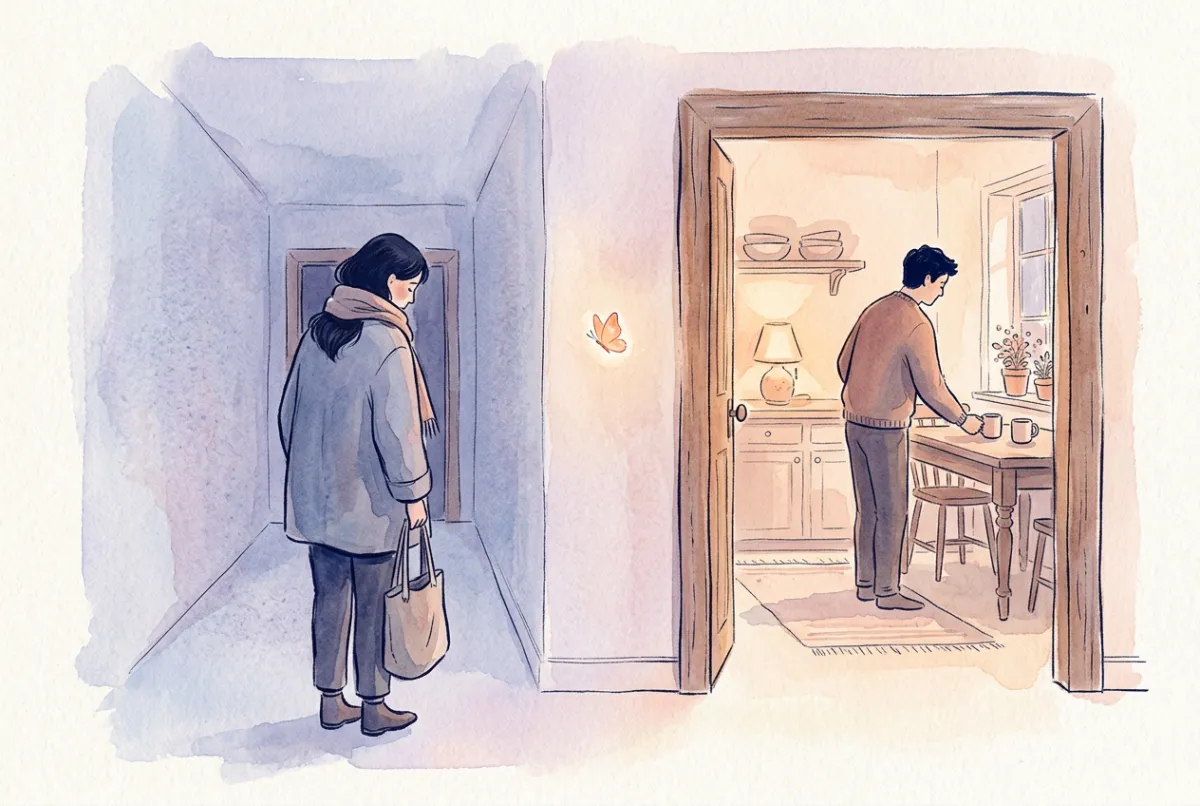
If you are reading this, you have probably already had the bad twenty minutes afterward, the ones where you replay your own tone and wonder what is wrong with you. Something predictable is happening, it has a shape, and the shape is workable.
One thing to be clear about first. This is about a hard day landing in the wrong room, not about a pattern. If the people you live with have started arranging their evenings around your mood, or if anyone has told you they are frightened of you, that is a different situation, and it deserves real support rather than an article about transitions.
The people you love are not the cause, they are the location
Here is the part worth understanding before any technique.
You did not choose to be sharp with them. All day you were regulating yourself in places where slipping felt expensive. Home is the one place where the cost of being your unpolished self feels low, because these are the people who have never made you pay for it. So that is where it lands.
This is not an excuse, and it is not a reason to accept it. But it does change what you are fixing. You are not fixing a lack of love. You are fixing where your stress gets put down.
What the research suggests about spillover
The pattern has been observed directly enough to be worth naming plainly.
In a study of forty three couples who kept daily diaries across five consecutive days, researchers found that husbands and wives reported more marital anger and withdrawal on days when they had negative social interactions at work, and wives also reported more of both after days of heavy workload. Because this was diary data rather than an experiment, it shows an association across days rather than proving that work stress causes the behavior at home. Still, the association held within the same person, which makes it a reasonably close description of what tends to happen on a hard day.
That word within matters. It is not that stressed people are worse partners in general. It is that the same person, on their harder days, reported behaving differently at home.
Stress leaks out in two shapes, not one
Most people think of this as snapping. Snapping is only half of it, and for many people it is not their half.
An earlier and much smaller study, of thirty three air traffic controllers and twenty seven wives surveyed across three days, found that on evenings when spouses were more supportive, higher work overload was associated with more social withdrawal and less expressed anger. The author suggested that withdrawing may help someone come back down to baseline. That was an interpretation offered alongside a small early study, so hold it loosely rather than treating it as settled, and note that the study framed withdrawal as something that might help rather than as damage.
What is worth borrowing from it is narrower: the observation that a hard day can show up as absence rather than volume. That second shape is the one people miss in themselves. Going quiet, answering in single words, being physically present and completely unreachable. Nobody gets yelled at, so it feels like you handled it. From the other side of the room it can land as being shut out, and it is harder to name than a raised voice, which means it often goes unrepaired for longer.
If you have been telling yourself you do not take things out on anyone because you never raise your voice, this is the question to sit with.
Put a gap between the day and the door
The most practical thing to try is also the least dramatic. Do not go straight from the thing that wound you up into the room with the people you love.
In a meta-analysis, researchers pooled thirty studies covering thirty four interventions with about three thousand seven hundred participants, all designed to help people mentally switch off from work during off hours. They found that these interventions had a modest average effect on how well people detached. Modest is the honest word, and worth saying clearly. The meta-analysis also measured detachment itself, not how participants treated their families, so treat this as support for the general idea of a deliberate transition rather than proof that it will fix your evenings.
In practice it is small. Sit in the car for five minutes before going in. Walk one extra block. Change your clothes before you talk to anyone. The point is not relaxation, it is a boundary the day cannot walk through with you.
Say it at the door, not after
If you only change one thing, change this.
Walk in and name your state out loud, before anyone has to work it out from your tone. Today was rough and it is nothing to do with you. I am at about twenty percent, give me half an hour. I am not upset with you, I am just still in it.
This is unglamorous, and in practice it tends to help, because the damage usually is not the mood itself. It is the other person quietly scanning back through the day trying to figure out what they did. Naming it takes that job away from them.
There is a version of this that goes wrong, which is announcing your stress as a permit. I have had a terrible day, said in a tone that means so do not ask anything of me tonight. The difference is whether you are giving them information or handing them a bill.
Name it to yourself first
You cannot say what you are feeling at the door if you have not worked out what it is.
In a brain imaging study, researchers found that putting feelings into words, which they called affect labeling, reduced amygdala activity relative to other ways of processing the same negative images, along with increased activity in a prefrontal region. That was a lab task with images rather than a bad Tuesday, so read it as a hint about how minds work, not a technique with a guaranteed result.
The practical version takes about a minute. Not I am stressed, which is too vague to do anything with. Try: I feel humiliated about how that meeting went, and underneath it I am scared I am not good at this. That is a specific thing, and a specific thing is easier to say out loud than a vague one, which makes it easier to put somewhere other than the nearest person.
When you have already snapped
You will still get it wrong sometimes. What you do in the next hour matters more than the slip.
Go back quickly, and keep it clean. I was short with you and you did not deserve it, I am sorry. Then stop. Do not attach because work was insane to the same sentence. The reason is true and it still turns an apology into a defense, and it leaves the other person holding both your stress and your justification for it.
Two things are worth adding once the apology has landed on its own. What was actually going on, if they want to know. And one concrete thing you will do differently, like taking the ten minutes before coming in rather than after.
Then, once things are genuinely calm, ask one more question: has this been happening more than I think. You may not enjoy the answer. It is the quickest way to find out whether you are in a hard week or a pattern, and it hands back some say to the person who has probably been quietly managing around it.
The repair is not a formality. Going back is the part that tells someone the relationship can survive a bad evening, which is usually the real question sitting underneath it.
How Murror helps with the evenings that go sideways
The hardest moment is the one where you can feel yourself getting sharp and you have nowhere to put it yet.
Murror is built for the part that comes after, when the person you were short with is still in the next room. You open up with a caring AI that helps you find the specific thing underneath the sharpness, which is usually closer to I felt dismissed today than to I am stressed. From there, Murror gently surfaces insights about the people in your life and small, low pressure ways to show up for them, through Moments to Care and your Connections, so a rough evening can turn into a specific step back toward the person it landed on. If it helps, you can turn something you worked through into a takeaway you share with someone you trust, on your terms. Everything stays encrypted and private by default.
Murror is not therapy, and it is not a substitute for the people you love. It is a quiet place to put the day down, so you can walk into the room as yourself.
You are not a bad partner, or a bad parent, or a bad friend. You are someone who ran out of the thing that keeps you gentle before the day was over. That is worth taking seriously, and it is also worth being kind to yourself about, because the person replaying their own tone at eleven at night is not someone who has stopped caring.
Frequently asked questions
Why do I take my stress out on the people I love most?
Often because they are the ones you are least afraid of losing. All day you hold yourself together in places where the cost of slipping feels high, with a manager, a client, a stranger. By the time you get home, most people have very little of that carefulness left, at least from the inside, and you are with someone who has rarely made you pay for being human. So the tension goes where it feels safest to go. That is not a good thing and it is worth changing, and it is also not a measure of how much you love them. Worth saying plainly though, this describes an ordinary hard day. If it happens most nights, or the people around you have started managing their behavior around your mood, that is a different situation and it deserves real support.
How do I stop snapping at my partner after work?
Put a gap between the day and the door, even a small one. Five minutes in the car, one walk around the block, a few minutes of not talking to anyone before you talk to them. Then say the thing out loud when you walk in: today was rough, it has nothing to do with you, give me twenty minutes and I will be a person again. Naming it in advance is the part that is easiest to skip, and it tends to do most of the work, because it stops the other person from having to guess whether they did something wrong.
How do I apologize for snapping without making excuses?
Name the behavior, skip the reason, then say what you will do differently. Something like, I was short with you last night and you did not deserve it, I am sorry. Notice what is missing. There is no because work was insane. The explanation is true, and it still belongs in a separate sentence, later, if they want it. Offered as part of the apology it converts into a defense, and the other person is left holding both your stress and your excuse for it. Say the apology cleanly first. You can explain afterward.