
How to Support a Friend Who Stopped Drinking
Updated 2026-09-29
Maybe they told you over coffee, a little awkwardly. Maybe you noticed a club soda where the usual drink used to be. Your friend has stopped drinking, for now or for good, and you are not quite sure what to do with that. You want to be supportive. You also, if you are honest, wonder what Friday nights are going to look like.
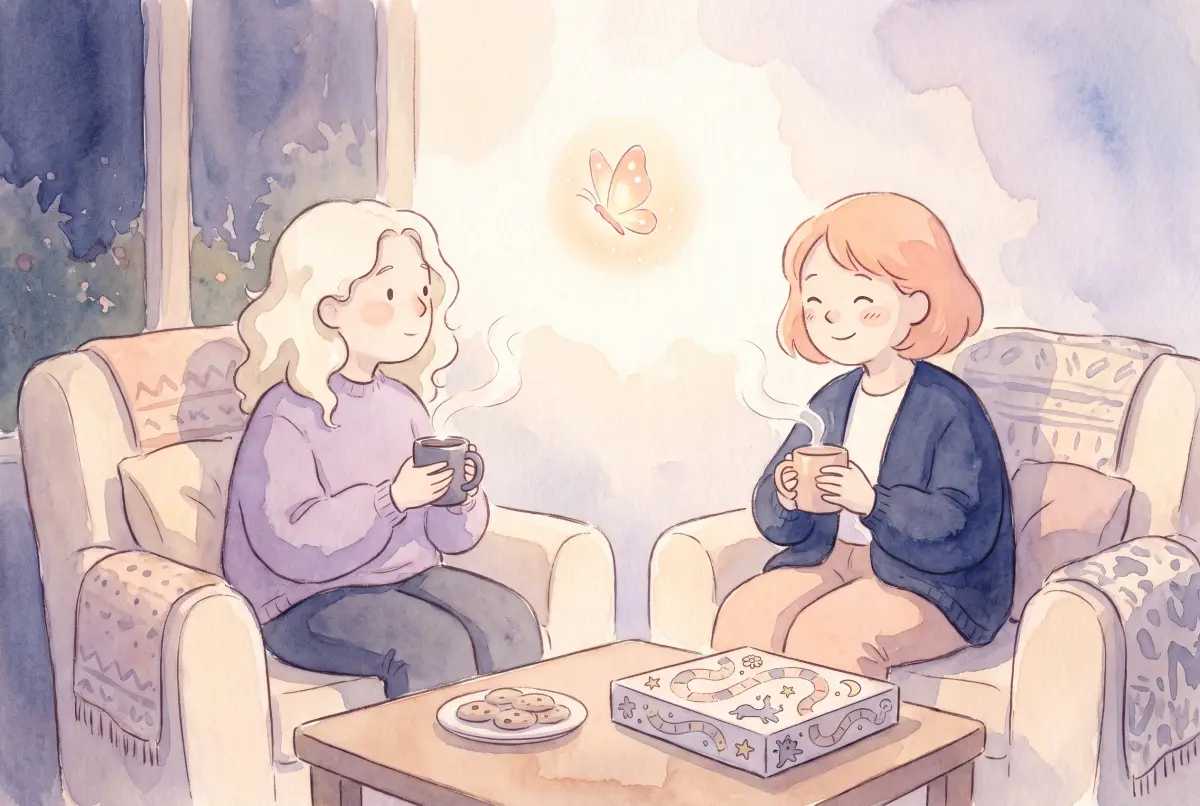
Both feelings are normal. This is not a guide to anyone's health or recovery. It is about the friendship: how to stay close to someone whose habits have changed, without making the change the only thing between you.
You do not need to know why
The first instinct is often to ask what happened. It comes from care, but it can land as a request to explain something that may be private, tender or simply boring. Some people stop for their health. Others stop for faith, money, pregnancy, medication, a season of life, a challenge like Dry January, or because they never really liked it. Some are in recovery, and some would rather not say.
You can skip the question entirely. "I am really glad you told me" and "I am glad to see you either way" can be true in many cases, and they ask nothing of your friend. If your friend wants to say more, they will, and how much they say is theirs to decide.
The ritual can be the hard part for a friendship
For many friendships, drinking is not just a drink. It is the standing Friday plan, the toast, the thing you do when you cannot think of what else to do. When it drops out, both people can feel a small vertigo: what do we do now, and are we still us?
Researchers who study people who drink little or not at all have found some clues about what helps. In a study of 25 young people aged 17 to 25 who drank moderately or not at all, Graber and colleagues interviewed them about social situations with and without alcohol. The themes they identified included feeling like you can be who you are, feeling like you belong, and making a free choice. It was a small, qualitative study in one region of England, so it cannot speak for everyone. But it suggests that what some people want is not a special exemption. It is to belong as themselves.
That is something a friend can give. It rarely takes a grand gesture. It takes making sure the same warmth is waiting for them, whatever is in their glass.
They may have already met some hostility
It can be easy to assume that not drinking is a small thing socially. It is not always. In an analysis of 511 free-text answers from British university students, Conroy and de Visser found that students described benefits of not drinking on a night out, including better health, higher self-esteem and a better quality social life. But about a quarter of the answers (26.6%) expressed hostility or ambivalence toward not drinking. Those are what the students themselves wrote, in a health program, so this is not a general rate. Still, it is a hint of how not drinking can be received among peers, and a friend who stops may already have met some jokes, some pressure or some raised eyebrows.
You can be the person who does not add to that. Nothing needs to be said. You just do not ask "come on, just one," and you do not turn their order into a talking point.
Why your own choices matter a little
There is a quieter reason to think about how you show up. In the Framingham Heart Study, Rosenquist and colleagues followed 12,067 people for up to 32 years and found clusters of drinkers and of abstainers across their social networks. Changes in the drinking of a person's friends and relatives were associated with changes in that person's own later drinking, while the drinking of coworkers and neighbors was not significantly associated. The study was observational and used a nonclinical measure of alcohol, so it cannot tell you what caused what.
It does not mean you must give up anything for your friend, and it is not a reason to feel guilty about a glass of wine. It is only one reason to think that the people around us may shape what feels easy, so a friend who stops may quietly be swimming against a current. And if reading this makes you think about your own drinking, that is worth noticing gently too. If you can make the current a little gentler for your friend, even by planning something where drinking is not the center, you are helping in a way that costs almost nothing.
There is also some evidence that feeling able to say no in social settings matters to people who set out to cut back. In a study of 857 British adults doing Dry January, de Visser and colleagues found that in simple comparisons, success was linked to more moderate drinking beforehand and more confidence refusing drinks. When the factors were considered together, having fewer drunk days in the prior month was the strongest predictor. Taking part was also associated with more confidence refusing drinks six months later, even for people who did not finish the month. It was a survey of people who chose to join, so it shows associations only. A friend who never pushes at least does not make that confidence harder to hold.
Small ways to keep the friendship close
Keep inviting them, and change the invitation, not the friendship. "Want to try the new ramen place Thursday?" or "Walk and coffee Saturday?" are easy yeses. A standing plan that does not depend on a bar is often a relief for both of you.
Ask once what would help, then believe the answer. "Is there anything that would make nights out easier for you?" is enough. Some people will say "Nothing, I am fine." Others will say "Maybe not the bar for a bit." Either is a real answer, and neither is a verdict on you.
Do not watch their glass. Hovering, checking or praising every order can feel like being monitored. Let it be the boring thing it is.
Do not make them the story. No toasts to their "brave choice," no announcing it to the table, and no telling other friends unless they have said it is okay. Let them decide who knows.
Be curious about the rest of their life. If the drink was the center of your time together, fill the space with genuine interest in what else is going on. Ask about their week, their work, the thing they have been meaning to try.
Stay patient with the wobble. Some plans may fall through or feel flat for a while. That is not a sign the friendship is over. It is a friendship finding its new shape. If your friend starts drinking again, the same care holds: no counting, no lecture, no verdict. It is not your job to keep score, and it does not undo the friendship.
If your friend's drinking hurt you
Not everyone reading this is simply supportive. If your friend's drinking earlier cost you something, whether it was a ruined night, broken promises or a scare, you may feel relief, but also anger or caution, and maybe grief for the friendship as it was. You are allowed all of that, and it is also okay to need some distance. Supporting a friend does not mean pretending nothing happened, and it does not mean you owe them constant availability. You can be glad for them and still take your time. If you are worried about your own safety around them, put that first, and reach out to someone you trust.
How Murror helps you show up for a friend
Changes like this are awkward to talk about, and it is easy to freeze, then drift, because you are afraid of saying the wrong thing.
Murror is an empathy practice built for moments like this. You open up with a caring AI companion that helps you understand what you are actually feeling, whether it is worry, awkwardness or a little sadness about the old routine, and think about what your friend might be feeling too. Over time, Murror surfaces gentle insights about your relationships and small, low pressure ways to show up, like a Moment to Care nudging you to suggest a Thursday walk, or a Connection that holds what you know about your friend and what matters to them. When a private reflection becomes something you want to say, you can turn it into an optional takeaway you choose to share with someone you trust. Everything stays encrypted and private by default. It is a companion and a bridge toward people, never a replacement for them, and never therapy.
The friend who stays the same
Your friend does not need you to be a coach or a counselor. Mostly they need to find that the friendship is still standing when the old routine is gone.
You do not need the reason. If and when you are ready, keep the invitations easy to accept, and let your friend be the same person at the table, with the same jokes and the same seat. Turning up, in small ways and at a pace you can sustain, is a real gift.
If anything here brings up worry for a friend, or for yourself, please reach out to someone you trust or a professional. That is not overreacting. It is taking care seriously.
Frequently asked questions
Should I ask my friend why they stopped drinking?
You do not have to. People stop for many reasons, including health, faith, pregnancy, money, a challenge like Dry January, or simply not enjoying it, and some reasons are private. A warm "I am glad to see you either way" fits many situations. If they want to tell you more, they will, and you can follow their lead.
Is it okay to keep drinking around them?
It depends on your friend, and the only way to know is to ask. Some people are comfortable with it, while others, especially early on, may prefer settings without alcohol for a while. Ask once, lightly, such as "Is there anything that would make our nights out easier?" Then believe the answer, and try not to take it personally either way.
What if I think my friend is struggling or in danger?
Stay warm and stay in touch, and let them know you are there without conditions. You do not need to manage anyone's recovery. If you believe they are in immediate danger, contact local emergency services. If they are working with a doctor, counselor or support group, your role is simply to be their friend.