
Journaling for Overthinking: How to Quiet a Racing Mind
Updated 2026-06-17
You replay the same conversation for the tenth time. You draft a reply, delete it, draft it again. You turn a small decision over and over until it feels enormous. Overthinking is exhausting precisely because it feels like work, like if you just think hard enough you will finally arrive somewhere. But the loop rarely lands anywhere. It just runs. If you know that feeling from the inside, you are not broken and you are not alone. Your mind is doing something very human, and there is a simple, well-studied way to interrupt it: put it on paper.
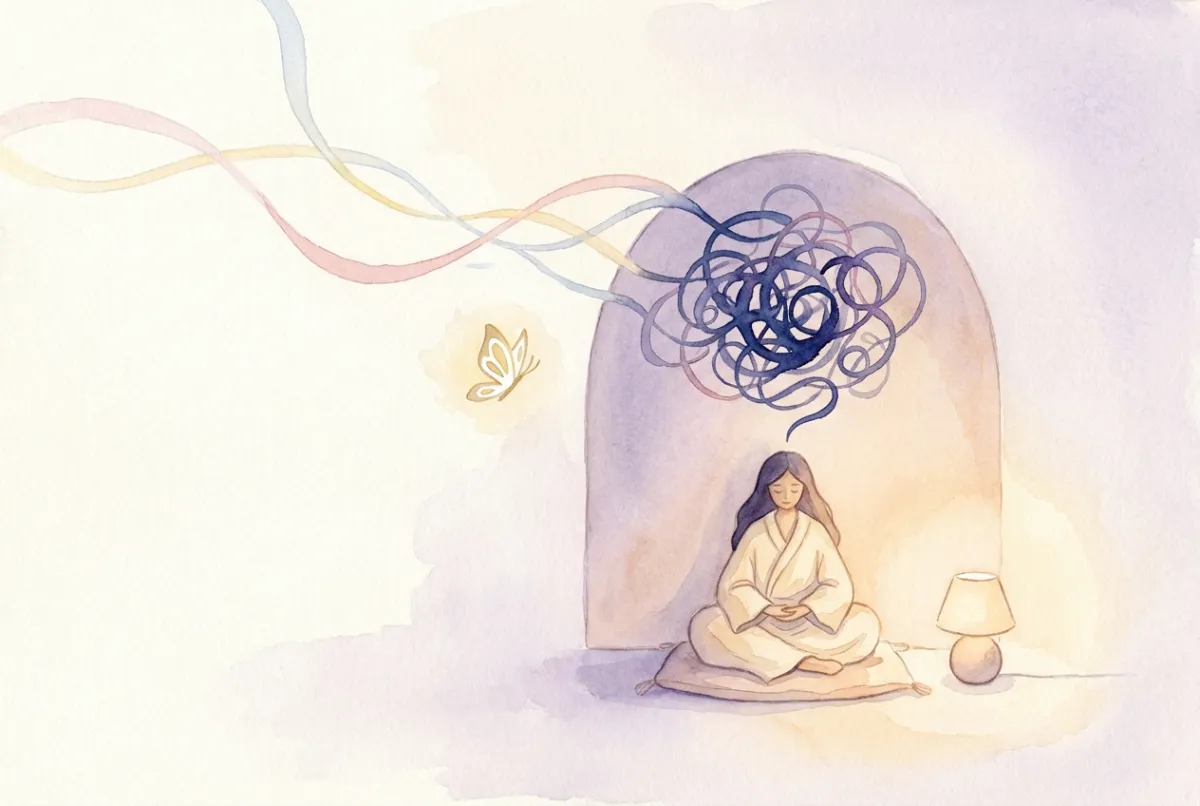
Overthinking is not problem-solving in disguise
It can be hard to let go of overthinking because it masquerades as being responsible. Surely all this mental effort is leading somewhere useful? Usually it is not. Psychologists draw a line between problem-solving, which moves toward a decision or an action, and rumination, which circles the same ground without resolving it. Rumination feels productive while producing almost nothing. The same thought returns not because you are close to an answer, but because your mind keeps the loop open, waiting for a resolution that thinking alone cannot give it.
This is why "just stop thinking about it" never works. You cannot win a fight against your own attention by using more attention. What helps is changing the medium. The moment a looping thought becomes words on a page, it stops being a process running inside you and becomes an object you can look at. That small shift, from inside to outside, is where journaling earns its place.
Naming the thought changes how your brain holds it
There is neuroscience behind why writing helps. Matthew Lieberman and colleagues ran experiments asking people to label their emotional reactions while viewing distressing images. They found that putting a feeling into words was associated with reduced activity in the amygdala, the region that processes emotional threat. The act of naming appeared to engage the prefrontal cortex, the part of the brain involved in regulation, which seemed to quiet the threat response.
This happened in a lab, with controlled conditions, so it is not a promise about your worst 2am spiral. But it points at something useful. When you write "I keep replaying that meeting because I am scared I looked incompetent," you are doing more than venting. You are translating a vague, looping pressure into a specific, named thing. Overthinking thrives on the vague. The more precisely you name what is actually bothering you, the less power the loop has to keep spinning.
You cannot get perspective from inside your own head
One reason overthinking traps you is that you are too close to it. You are inside the experience, narrating it as it happens, which keeps the emotional charge high. Ethan Kross and Ozlem Ayduk, in a review of research on self-distancing, described how taking a small step back from your own experience, observing it as if from a slight distance, was associated with less rumination and a calmer reaction than reliving it up close.
Journaling is one of the easiest ways to create that distance. A simple trick: write about yourself in the third person, or as if you were a caring friend looking at your situation. Instead of "I cannot believe I said that," try "She was embarrassed about what she said, and underneath that she was worried about being judged." It can feel slightly strange at first. But that small grammatical shift is doing real work, giving you enough room to see the thought instead of being inside it.
What expressive writing research actually shows
It is worth being honest about the size of the effect. A large meta-analysis by Joanne Frattaroli reviewed 146 randomized studies of expressive writing and found a small but statistically significant average benefit for psychological and physical wellbeing. The effect was modest, around a small effect size, and it varied a lot depending on the person and the context. Writing is not a cure, and anyone who tells you it transforms your mind overnight is overselling it.
What the research does support is gentler and more durable: for many people, writing about emotional experiences is associated with a small, real shift, and small shifts repeated over time tend to add up. You are not trying to fix overthinking in one entry. You are building a habit that, on most days, gives the loop somewhere to go.
When overthinking keeps you awake
Overthinking often gets loudest at night, when the distractions fall away and the open loops get the stage to themselves. Here the research gets surprisingly specific. In a sleep study by Michael Scullin and colleagues, participants who spent five minutes writing a specific to-do list at bedtime fell asleep faster than those who wrote about tasks they had already completed. The more detailed the list, the faster they drifted off.
The likely reason is offloading. When tomorrow's unfinished tasks live only in your head, your mind keeps rehearsing them so it does not forget. Writing them down, specifically, seems to give your mind permission to stop holding them. If your overthinking is mostly future-facing, a worry about what you have not done yet, a five-minute bedtime list is a small, evidence-informed place to start.
Four ways to journal your way out of a spiral
You do not need to write well or reach a conclusion. Try whichever of these fits the moment:
Empty the loop. Set a timer for five minutes and write down everything circling in your head, no order, no editing. You are not solving anything, just moving it out of the background and onto the page so it stops using up attention.
Name what is underneath. Once it is out, ask: what am I actually afraid of here? Write the most specific version you can. "I am worried they think I am unreliable" beats "I feel bad about it."
Switch to the third person. Rewrite the situation as if describing a friend you care about. Notice how the advice you would give them is usually kinder, and clearer, than the loop you were running.
Sort what is yours to hold. Draw a line down the page. On one side, what is actually in your control today. On the other, what is not. Overthinking blurs that line. Writing it out redraws it.
How a caring companion deepens this
The hardest part of journaling when your mind is racing is often the blank page itself. You sit down to write and the loop, which had so much to say, suddenly does not know where to start.
Murror was built for exactly that moment. Each day begins with a gentle mood check-in where you choose three feelings that are present right now, giving the loop its first small act of naming before you have written a word. From there you write a private journal entry, and a caring AI companion reads what you shared and reflects it back. Sometimes it offers more precise language for what you are circling. Sometimes it asks one quiet question that helps you step back and see the thought instead of spinning inside it.
Your entries stay encrypted and private. Nothing is shared unless you choose to. If there is someone you trust, you can optionally share specific moments through Moments to Care, letting them see how you are doing without needing to explain the whole spiral out loud.
Murror is not therapy and it is not a replacement for the people who know you. It is a companion and a bridge, a place to set the loop down for the in-between moments so you can understand yourself well enough to carry the rest more lightly.
Overthinking will not vanish because you wrote one entry. Some nights the loop will still find you. But you do not have to face it with nothing but more thinking. A few minutes, a page, and a willingness to name what is already there can be enough to loosen the loop's grip, just a little. That little is real, and it is repeatable. You can start tonight.
Frequently asked questions
Can journaling actually stop overthinking?
It will not switch your mind off, but it can change your relationship to the loop. Writing a thought down moves it from a circling background process to words you can look at. In studies, putting feelings into words was associated with a calmer threat response, and expressive writing was associated with modest improvements in wellbeing over time.
What should I write when I am overthinking?
Start by emptying the loop onto the page without trying to solve it. Then name the feeling underneath as precisely as you can, and write about yourself in the third person if that helps you get a little distance. The point is not a tidy conclusion, it is getting the thought out of your head and into something you can see.
Why do I overthink most at night?
At night there are fewer distractions, so unfinished thoughts get louder. In one sleep study, people who wrote a specific to-do list for five minutes at bedtime fell asleep faster than those who wrote about completed tasks. Offloading the open loops onto paper seems to help the mind let go of them.
Is overthinking something I need help with?
Journaling is a supportive tool, not a treatment. If overthinking is taking over your sleep, your relationships, or your ability to function day to day, talking with a mental health professional is the recommended next step. Writing can sit alongside that, not replace it.