
How it works
A gentle space to know yourself and the people you love.
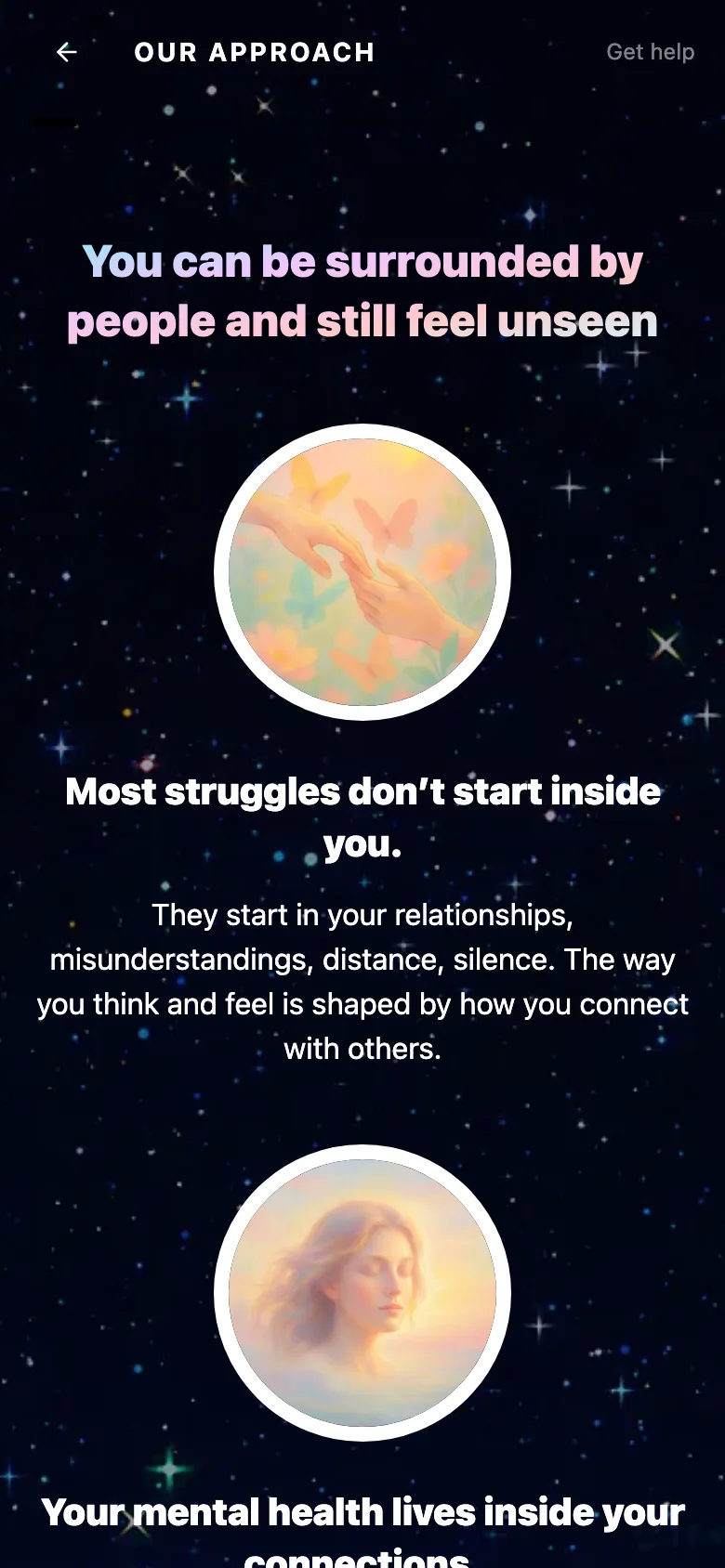
Murror is not a productivity tool or a therapy app. It is a private companion that listens while you write, helps you understand what you feel, and quietly nudges you toward the real relationships that matter.
Why Murror is different
Four things we believe that most apps do not.
Inner work that brings you closer.
Understanding yourself is only the start. Murror turns what you learn into how you show up for the people you love, so reflection reaches outward into real connection.
Companion, not therapist.
Murror is a place to be heard, not a clinical tool. It will never diagnose, prescribe, or replace a trained professional. It is the kind of space you can open at 2am without pressure.
Your wisdom reflected back.
The insight belongs to you. Murror mirrors your own words and patterns back so you arrive at clarity yourself, rather than being handed a verdict by an algorithm.
Privacy is the prerequisite.
You cannot be fully honest with something you do not trust. Murror is designed so your inner world is private by default. No one sees what you write unless you choose to share it.
Everything inside
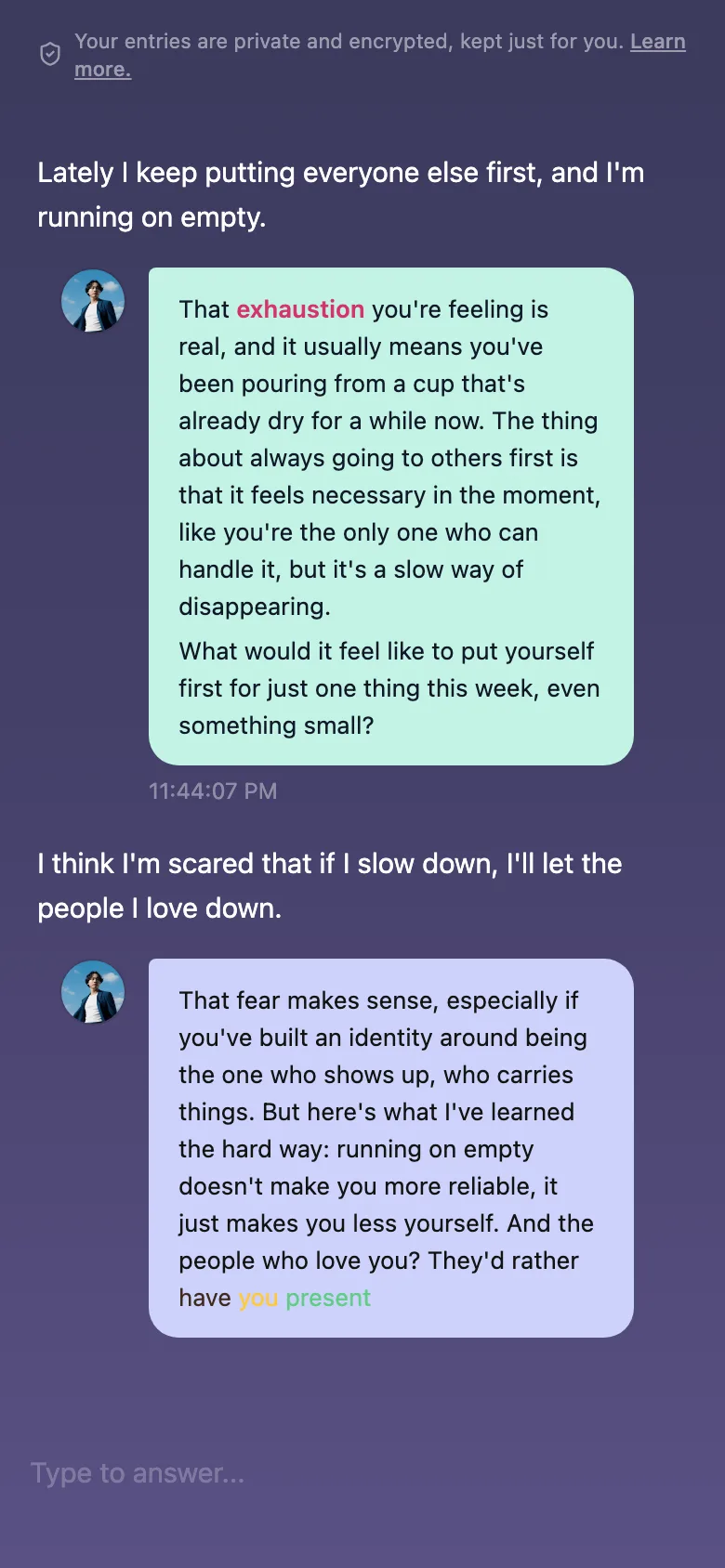
Deep-Chat
Your emotional journey, one conversation at a time.
A live chat surface where you write a message and your chosen voice replies in a real conversation: asking a gentle follow-up, reflecting the emotions it heard in your words, and staying with you until the entry finds its shape.
Open the composer and choose a voice that feels right for today.
Write your first message, as short or as long as you like.
Your voice replies, reflects back what it heard, and asks one gentle follow-up question.
Keep the conversation going, or let it rest. There is no minimum and no pressure.
At the end, your emotional journey appears: the feelings named, the arc of the exchange, the moment it shifted.
Why different
This is not a form you fill in and not a bot that lectures. It is a real back-and-forth: you write, it listens, it asks, you go deeper. The insight arrives in your own words, shaped by the conversation.
Naming a feeling in conversation (affect labeling) is associated with reduced amygdala reactivity, which may help the feeling become more manageable. A richer emotional vocabulary is also associated with higher wellbeing, an effect researchers call emotional granularity. Lieberman et al., 2007; Vine et al., 2020
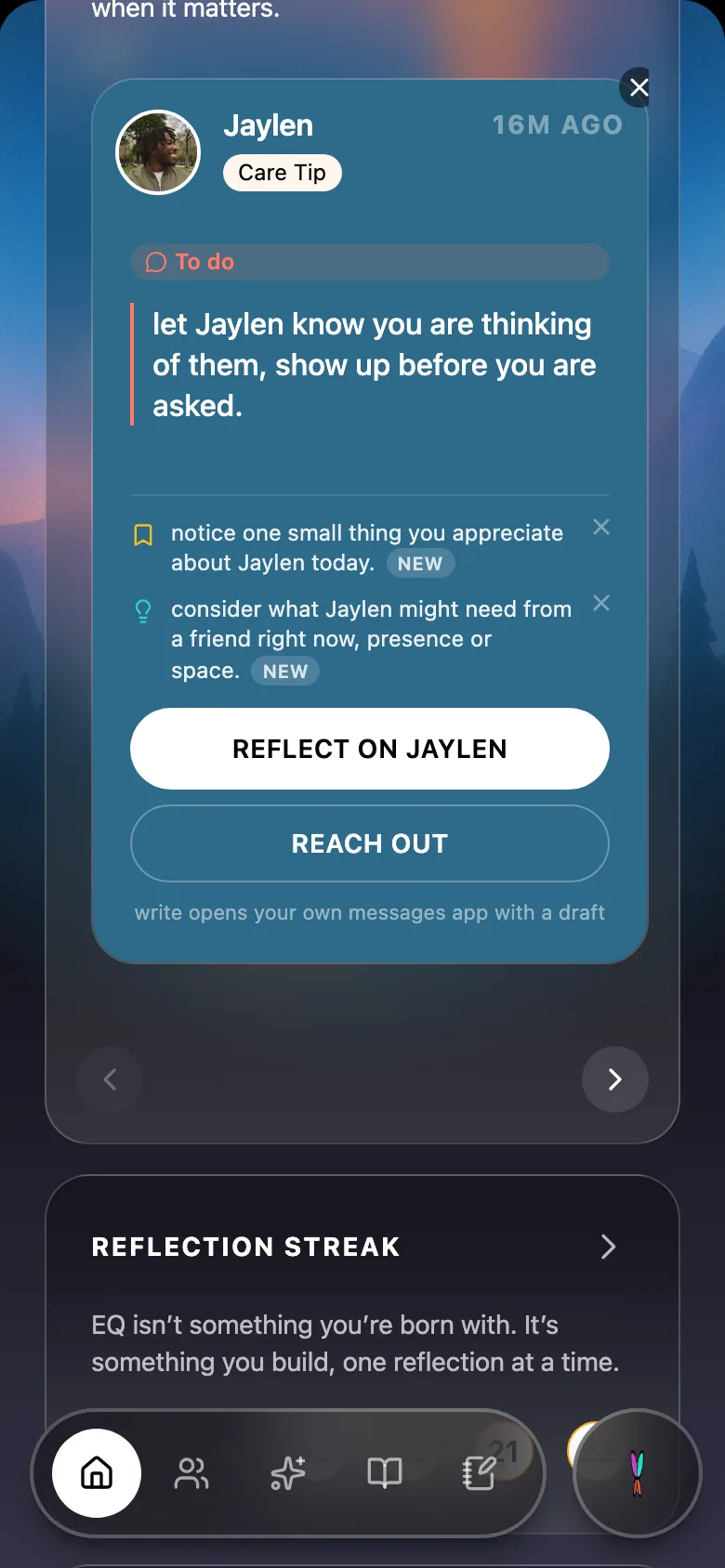
Moments to Care
Small, daily acts toward the people who matter.
A gentle daily home feed of soft, personalized cards about the people you care about: an insight, a nudge, or a 5-minute care tip, each with a Reflect or Write button so the understanding becomes an action.
Open home. A small card about someone you love appears at the top.
Read a warm insight about how things have been between you two lately.
Tap Reflect on [Name] to open deep-chat already focused on them, or tap Write to send a message.
Or take a tiny care challenge: one small, low-pressure gesture toward a real relationship.
Why different
Understanding without a next step stays theoretical. This turns insight into one small action toward a real person. The barrier to reaching out shrinks to a single tap.
Connection is protective. Brief, low-key contact with people we care about still counts and helps counter the isolation gap. The research linking social connection to wellbeing is among the most robust in public health. Holt-Lunstad et al., 2015; U.S. Surgeon General, 2023
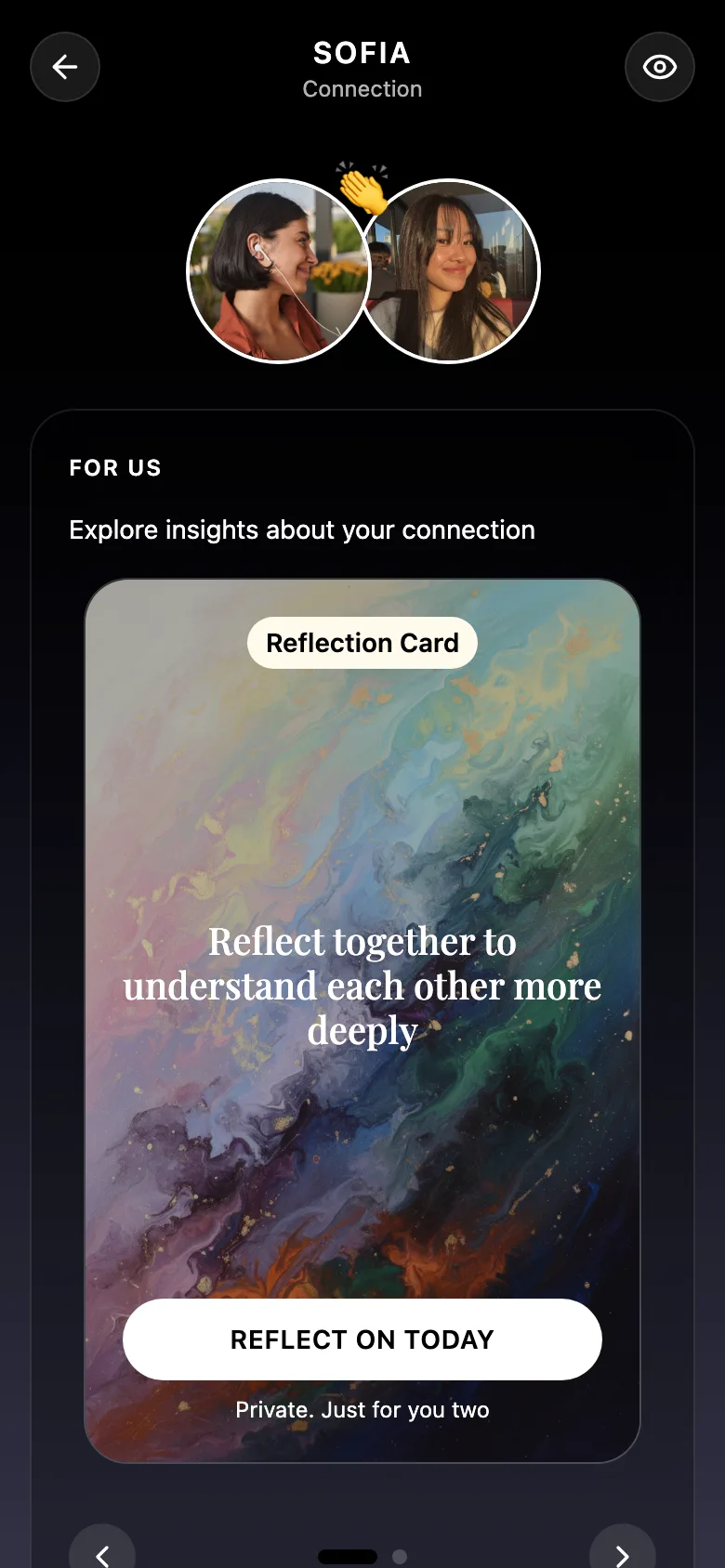
Connections
Keep the people you love close.
Each person you care about becomes a small, warm space: a daily insight about the relationship, gentle ways to reach out, mini check-ins, and shared takeaways that both of you can see.
Tap a person from your connections list.
See a warm insight about how you two have been relating lately.
Send a small thinking-of-you message, or take a tiny challenge together.
Reflect on them, then share the takeaway if you want.
Over time, the space holds a picture of what this relationship means.
Why different
Inward reflection becomes outward connection. The act of reaching out, which can feel high-stakes, shrinks to a gentle nudge. You are not managing a contact list; you are tending a relationship.
Perceived loneliness is shaped partly by how we interpret connection, not only by how much of it we have. Small contact still counts. Even brief interactions with close others are enough to register as meaningful in the research. Holt-Lunstad et al., 2015
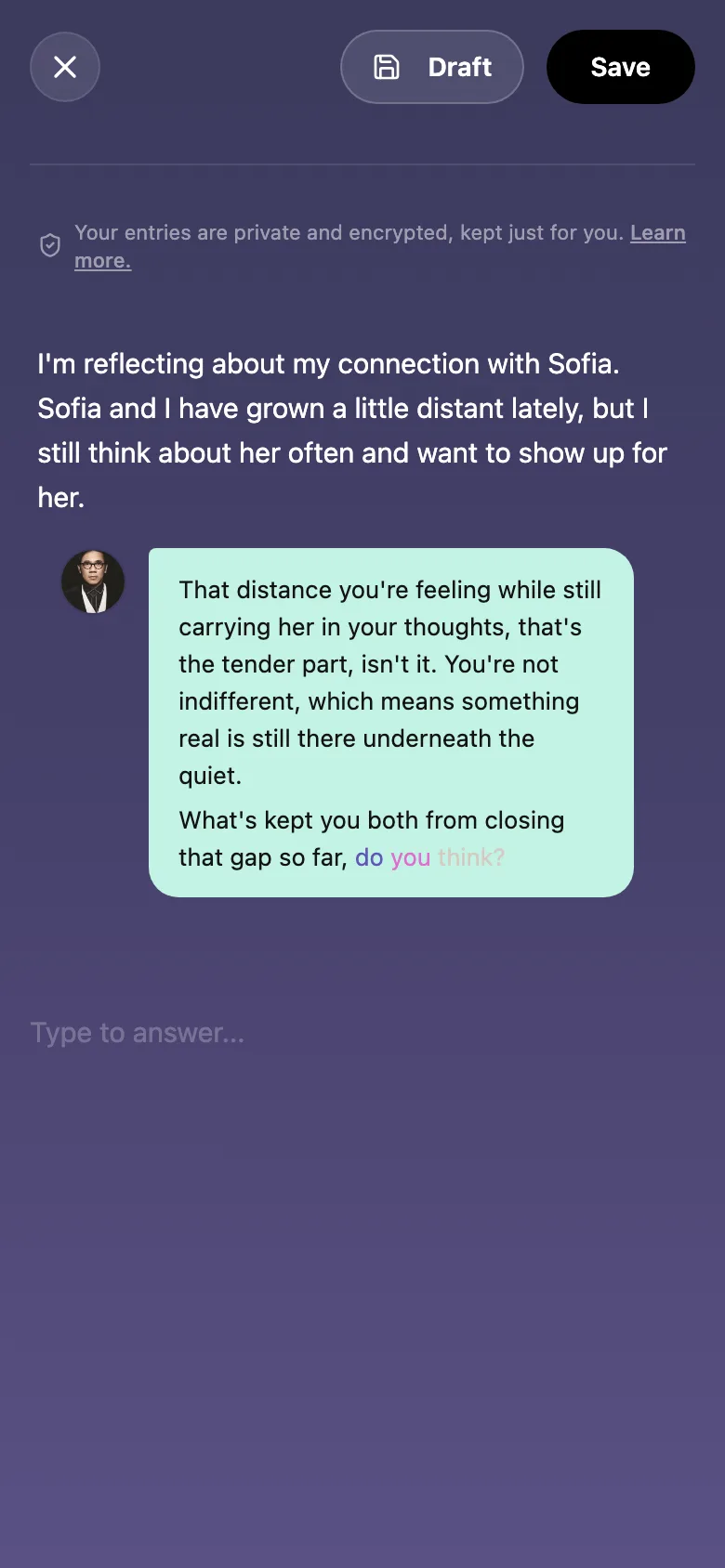
A takeaway you can act on
Turn a private reflection into a small step toward someone.
When you reflect about a specific person, Murror returns a gentle relational insight alongside your emotional reflection: a quiet observation about what might be present in that relationship, with an optional small step you can take toward them.
Open up about or reflect on a specific connection.
Read your personal emotional reflection first.
Below it, a relational insight appears: something quiet and honest about the relationship.
An optional gentle action is offered, never pressured.
Share the takeaway with that person if you want, or keep it for yourself.
Why different
Most reflection stays private and internal. Connection Reflection turns a private moment into an optional bridge: a small, offered step toward the real person, so the insight does not just sit in the app.
Maintaining close relationships through small, intentional contact is one of the strongest predictors of long-term wellbeing in social connection research. Even low-effort gestures matter when they are genuine. Holt-Lunstad et al., 2015
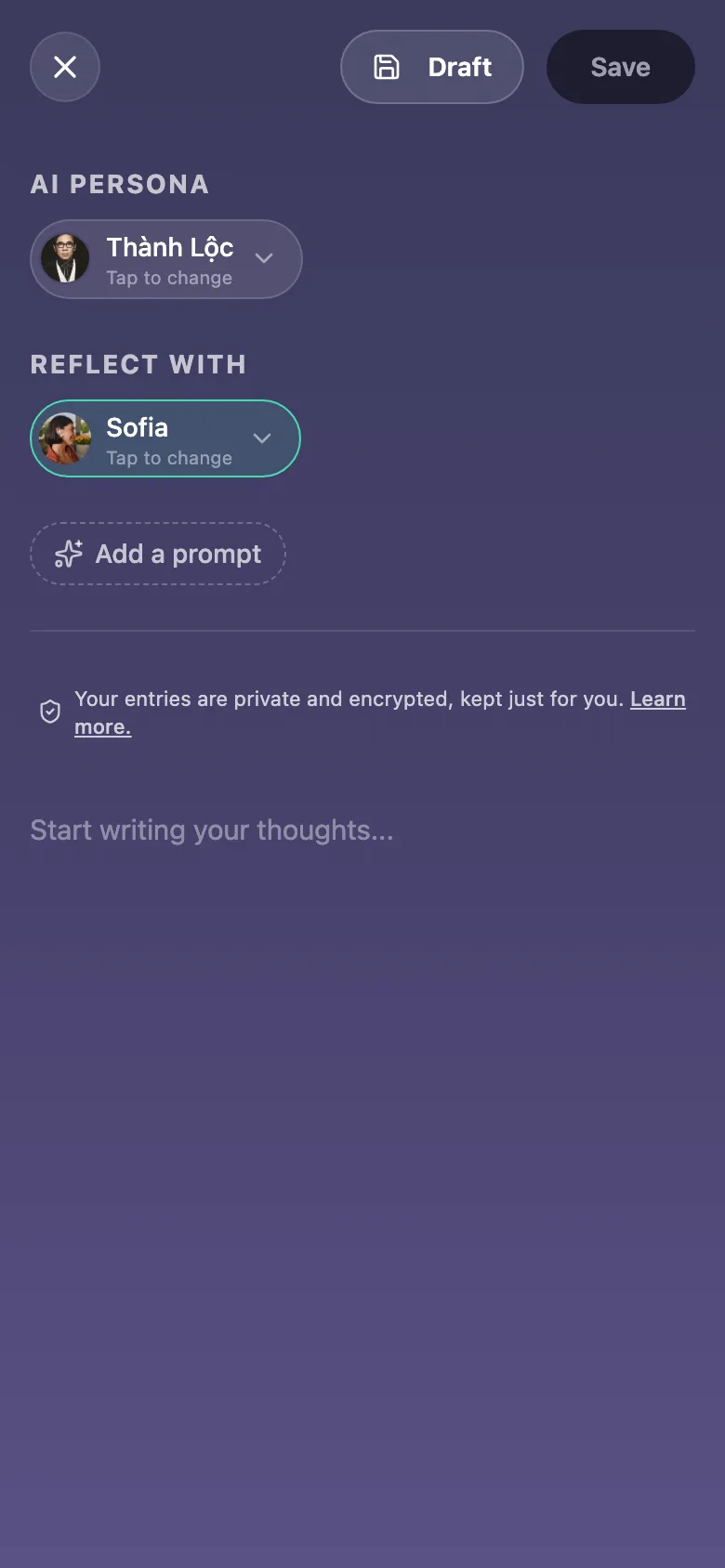
Reflect with someone
Some feelings are really about one person.
In the composer, you can choose to address the entry to a specific person in your connections instead of writing for yourself. The reflection is then tuned to that relationship, not just your own internal state.
Open the composer.
Tap "Reflect with" and choose a person from your connections.
Write as you normally would, but with them in mind.
The reflection that comes back is shaped around that relationship.
You can share it with them or keep it private.
Why different
Most reflection apps assume you are writing only to yourself. Reflect With lets you write toward a specific person, which changes what surfaces. The AI hears the relational context and reflects back what matters for that connection.
Expressive writing about a specific relationship, rather than general emotions, may help clarify feelings about that person and what you want from the relationship. Perspective-taking about another person is associated with greater empathy and more constructive relationship behavior. Frattaroli, 2006
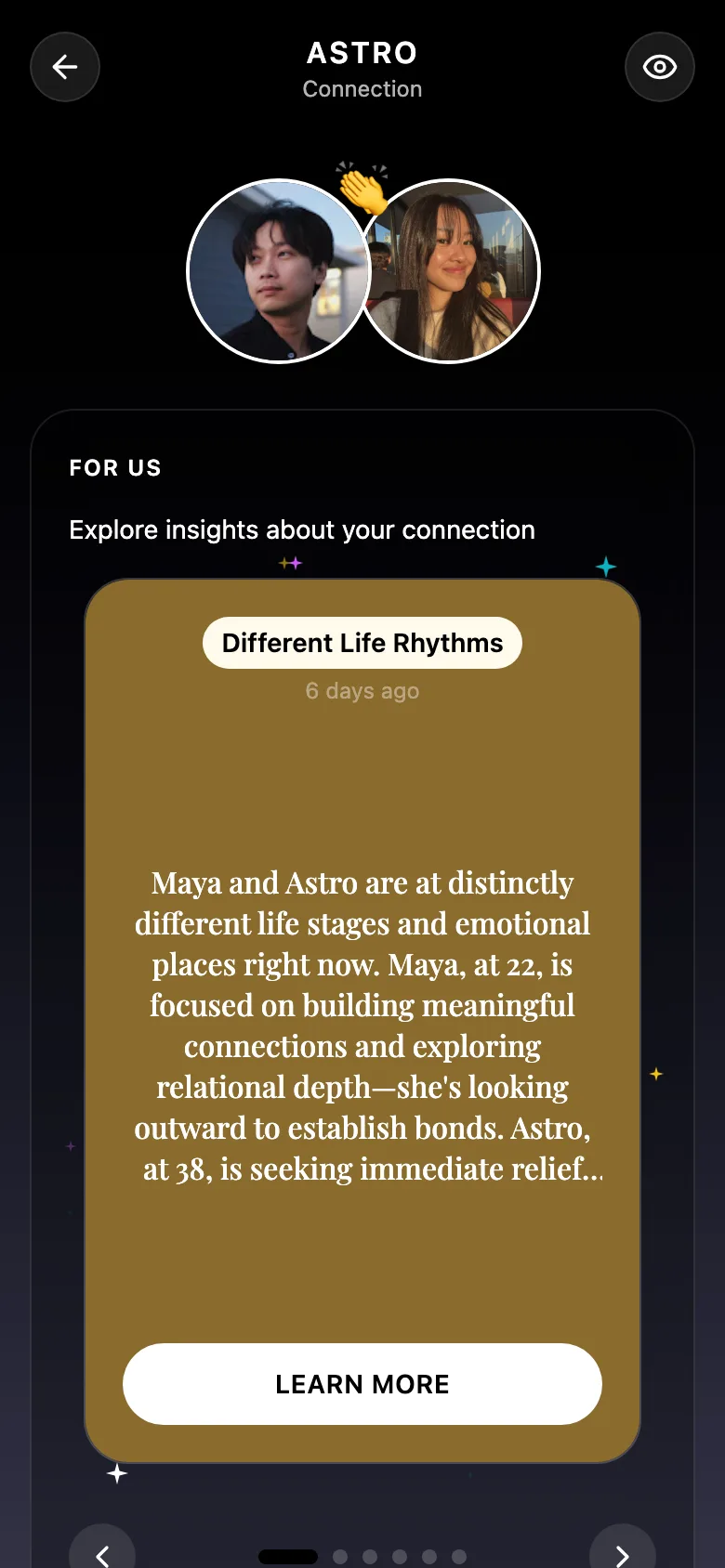
A lens on your connections
A different way to see where someone is coming from.
A reflective insight card that offers a lens on a relationship, like differing life rhythms or temperaments, to help you understand why a connection might feel out of sync right now. It is a prompt for empathy, not a prediction.
Open a connection's profile.
Find an insight card framed around a relational lens.
Read how it might help you see where the other person is coming from.
Use it as a starting point for curiosity, not as a verdict.
Tap Learn more to explore further.
Why different
This is not fortune-telling or fate. It is a reflective lens, a way to ask: what might be going on for them right now that I am not seeing? The value is in the empathy the question opens, not in any predictive claim.
Perspective-taking, actively imagining another person's situation and inner state, is associated with increased empathy and reduced interpersonal conflict. The relational lens here is a tool for that kind of reflection, not a validated predictive framework.
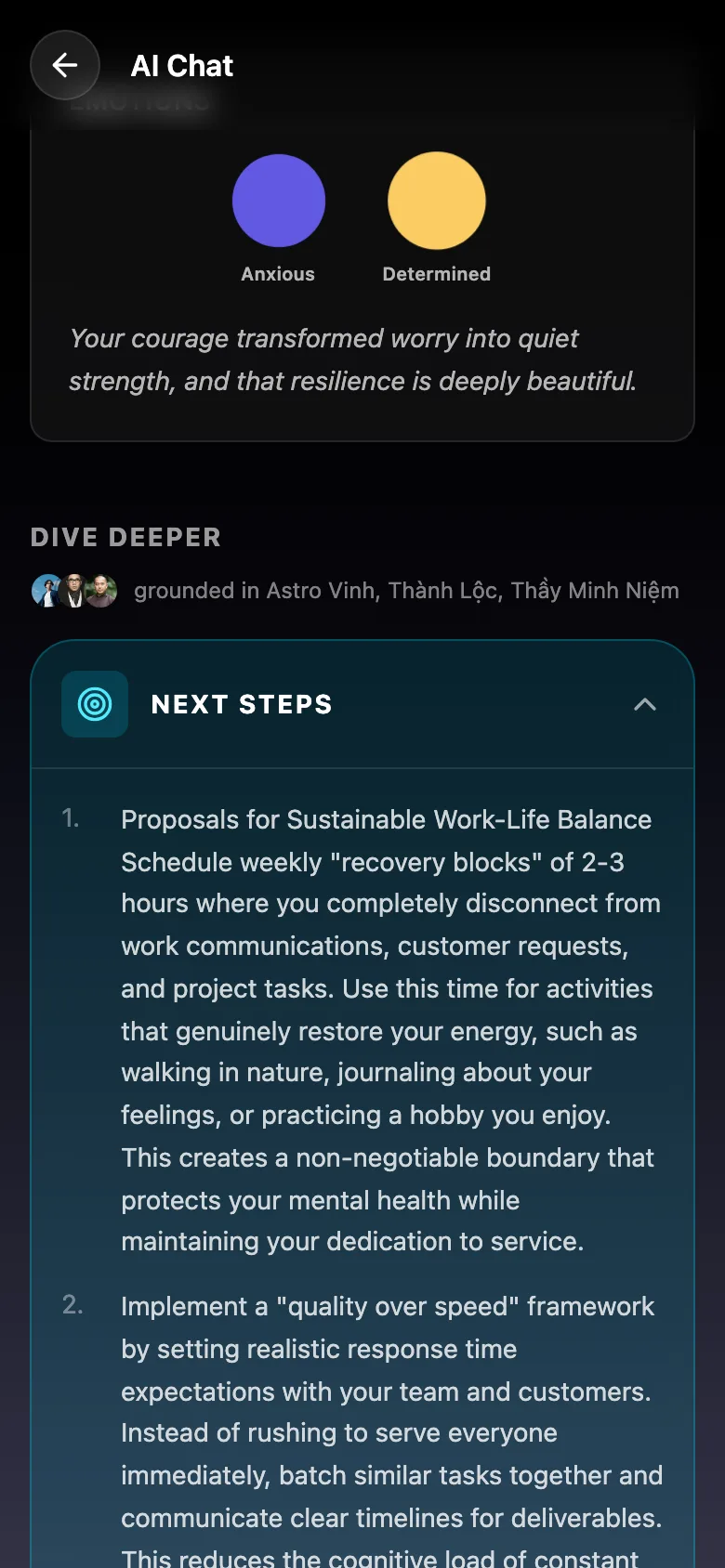
Name what you feel
Put words to what is happening inside.
After you write, Murror surfaces the precise emotions it heard in your entry as named chips, then adds a line on how they relate to each other. Not just "sad" or "okay," but the finer grain underneath.
Write or talk through what is on your mind.
Named emotion chips appear: Anxious, Determined, Relieved, and so on.
A single line shows how they connect: how one feeling gave way to another, or how two coexist.
Over time you build a richer vocabulary for your own inner life.
Why different
Most apps ask you to pick an emoji mood. Murror names the precise emotion and shows how several feelings coexist in the same moment, building your vocabulary entry by entry.
Affect labeling, putting a precise name to a feeling, is associated with reduced amygdala reactivity. Emotional granularity, having a richer vocabulary for distinct feelings, is associated with higher wellbeing and better regulation. Both effects are modest but replicated. Lieberman et al., 2007; Vine et al., 2020
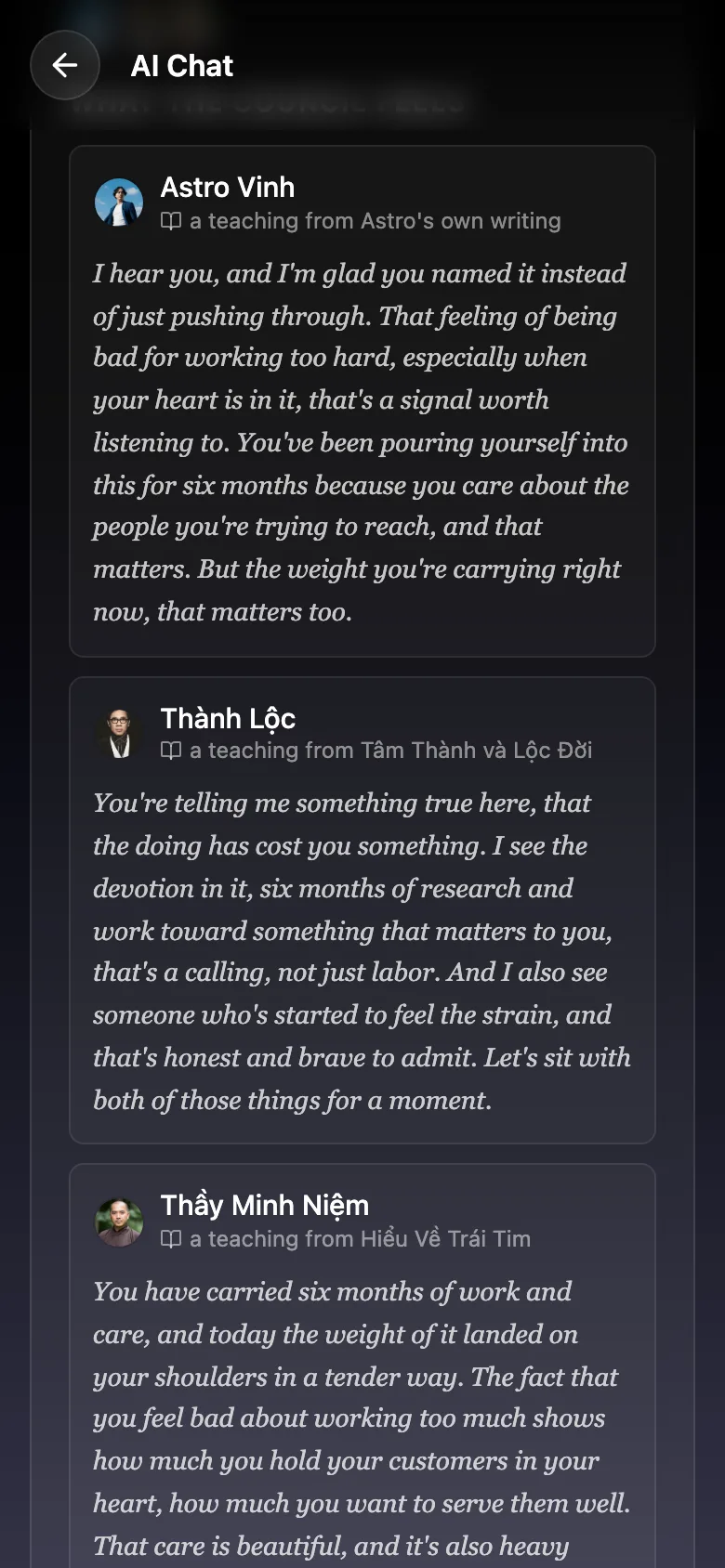
Council of Advisors
Several real voices on the same moment.
After you write an entry, a panel called "What the Council thinks and feels" appears. Each advisor, drawn from real people whose words Murror is grounded in, offers their own short take on what you wrote.
Write your entry as usual.
Scroll past your own reflection to the Council panel.
Read Astro Vinh's take, then Thanh Loc's, then Thay Minh Niem's.
Each speaks from their own perspective and their own writing, not a generic script.
Notice which resonates. You do not have to agree with any of them.
Why different
One AI voice gives you one angle. The Council gives you several real human philosophies responding to the same moment, each grounded in that person's actual words, so you can find the perspective that fits rather than accepting the first answer.
Hearing the same situation described from multiple perspectives is associated with lower emotional reactivity and richer meaning-making, effects studied under self-distancing and cognitive reappraisal research. Seeking several viewpoints before settling on one is a well-documented aid to clearer thinking. Kross & Ayduk, 2011
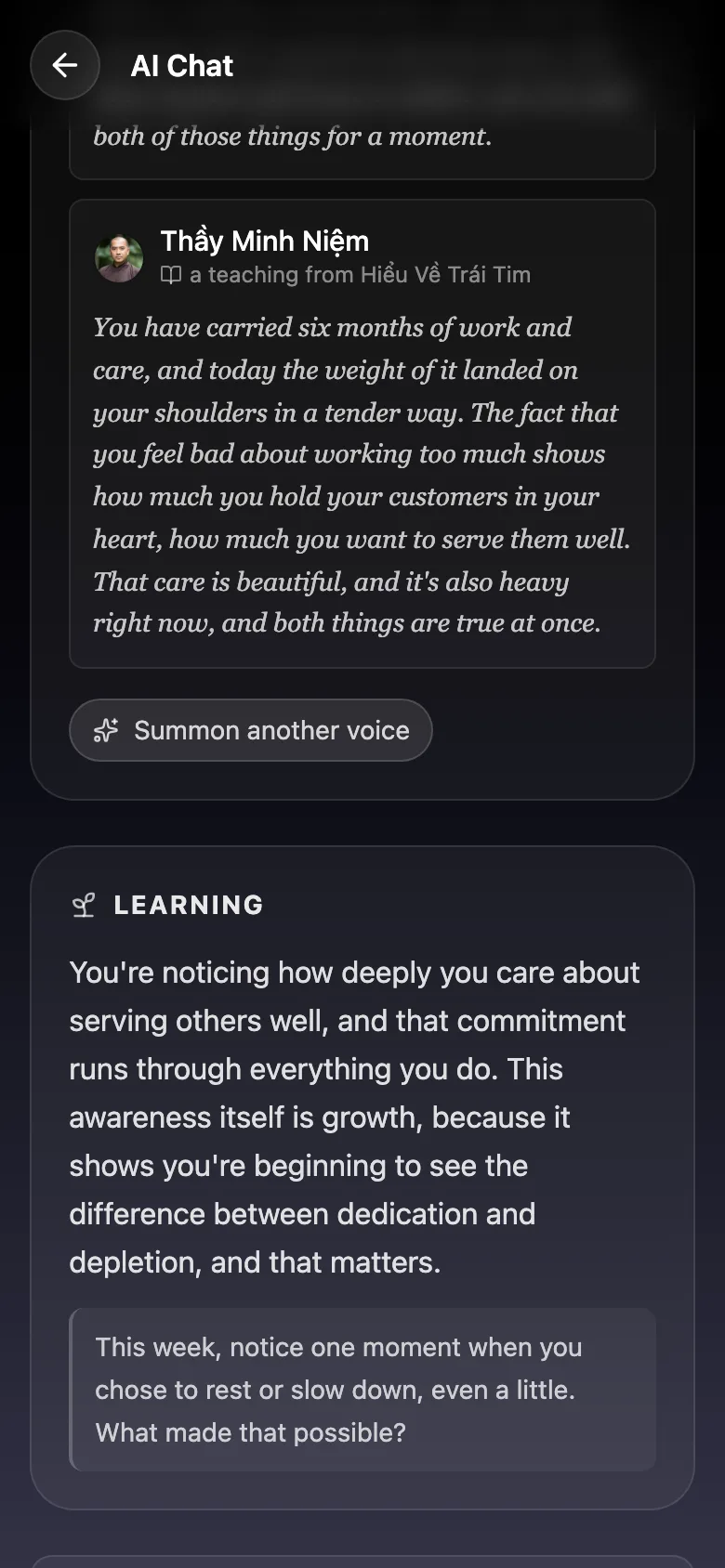
Grounded in real wisdom
A reflection rooted in someone's actual words.
When a persona like Thay Minh Niem responds to your entry, the reflection is drawn from his real book and attributed explicitly: "from Hieu Ve Trai Tim." Not invented comfort, but a genuine teaching applied to your moment.
Write an entry with a persona active.
The reflection arrives with a source note: the book and the teacher it comes from.
Read the teaching as it applies to what you actually wrote.
The avatar and name of the teacher appear so the voice is never anonymous.
Why different
Generic AI advice can feel hollow because it comes from nowhere. Murror's reflections are grounded in real teachers' actual books, attributed honestly, so you know whose wisdom you are reading and can follow it further if it helps.
Reading and reflecting on meaningful texts, sometimes called bibliotherapy, has a modest evidence base for supporting mood and self-understanding. The effect is real but small and works best when the reader finds the material personally relevant.
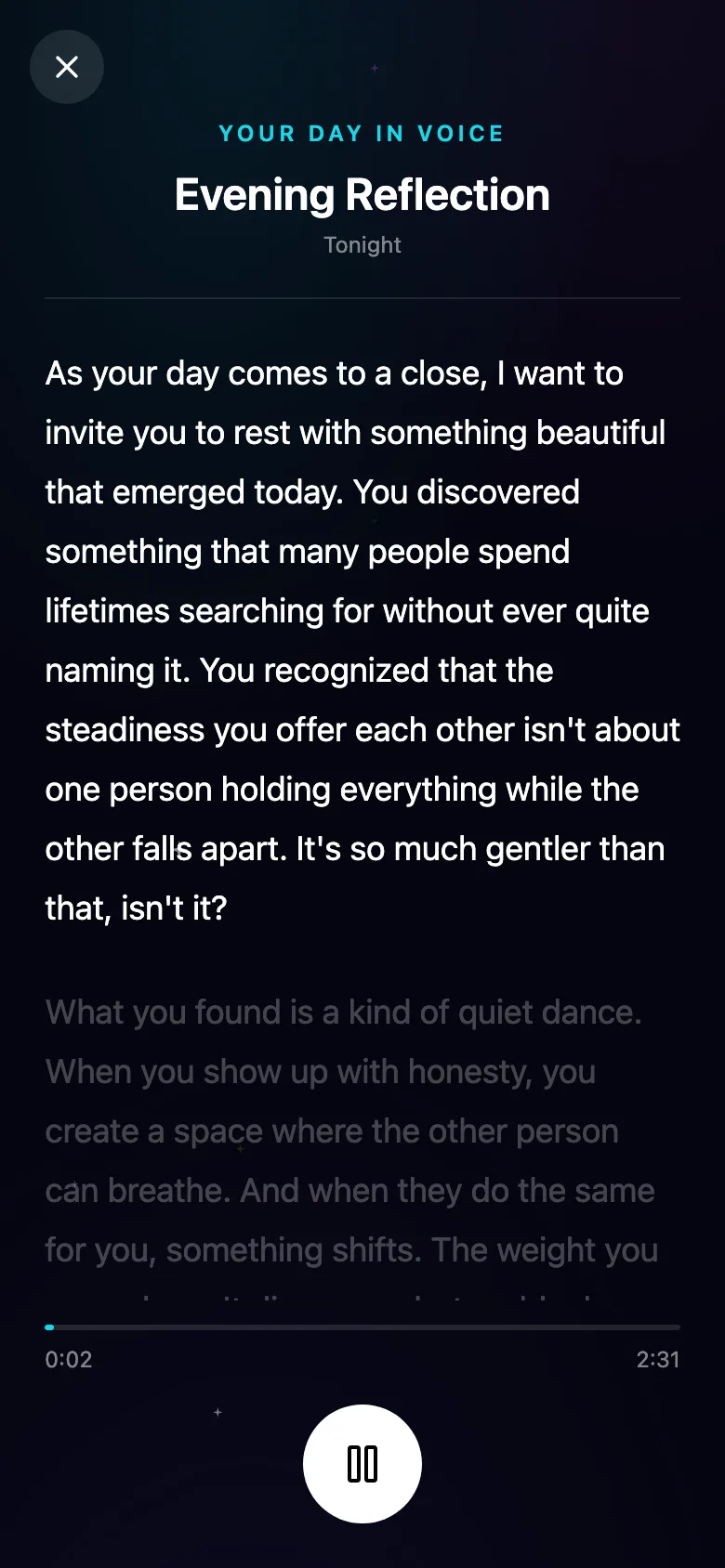
Your Story So Far
A wind-down ritual for heavy nights.
After 7pm, a card offers to read your day back to you. A night-sky screen appears, and a calm voice reads your own words aloud, paragraph by paragraph, set to gentle piano. The day becomes a story you can hold.
After 7pm, a soft card appears on your home feed.
Tap it. A night-sky player opens.
Press play. A calm voice reads your entry back to you, gently.
Paragraphs glow in time with the voice. The pace is yours.
When it ends, the day has been witnessed. You can sleep lighter.
Why different
Most apps end the day with a metric. Murror ends it with a moment: a wind-down ritual that gives a heavy night a chance to find a lighter morning.
Expressive writing and structured reflection are associated with modest improvements in wellbeing across a large body of research (a 2006 meta-analysis of 146 studies found a real but modest effect). Self-distancing, hearing your own story from a small remove, may help with processing difficult moments. Effects are real, though not dramatic. Frattaroli, 2006; Kross & Ayduk, 2011
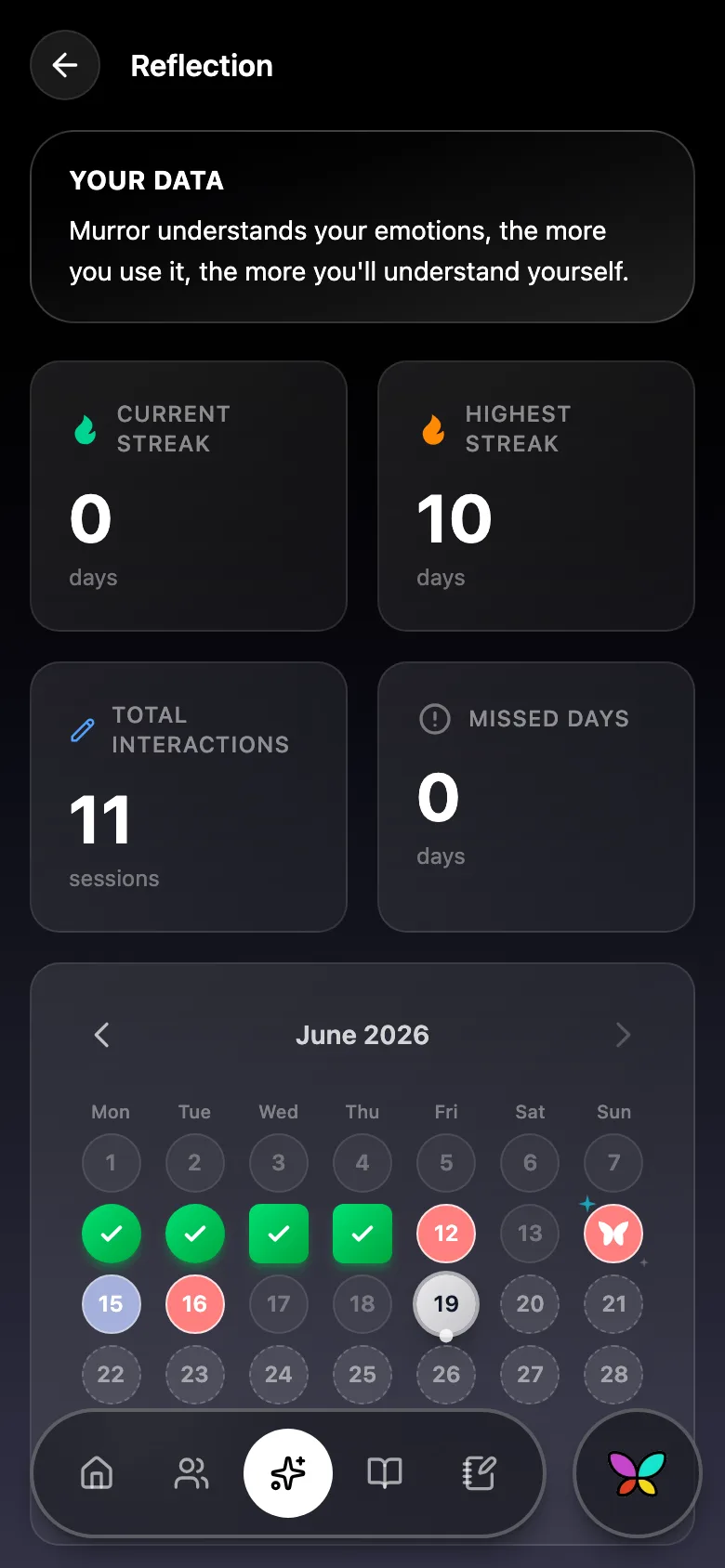
Reflection
See yourself steadying.
A calm dashboard: your current streak, an emotional-trajectory line that shows your mood trending over time, and a mood-colored calendar you can scroll back through to revisit any day.
Open Reflection from the home bar.
See your streak and your emotional trajectory line at a glance.
Scroll the mood-colored calendar backward through your history.
Tap any brighter day to revisit what you wrote.
Notice: the hard days did pass. The lighter ones were real.
Why different
Progress made visible reinforces that reflection works. Murror surfaces your patterns after a handful of entries, not months, so the feedback arrives while it is still useful.
Short feedback loops matter for habit formation. Seeing your own emotional patterns, even in a simple line, can make the effort feel meaningful and encourage you to return.
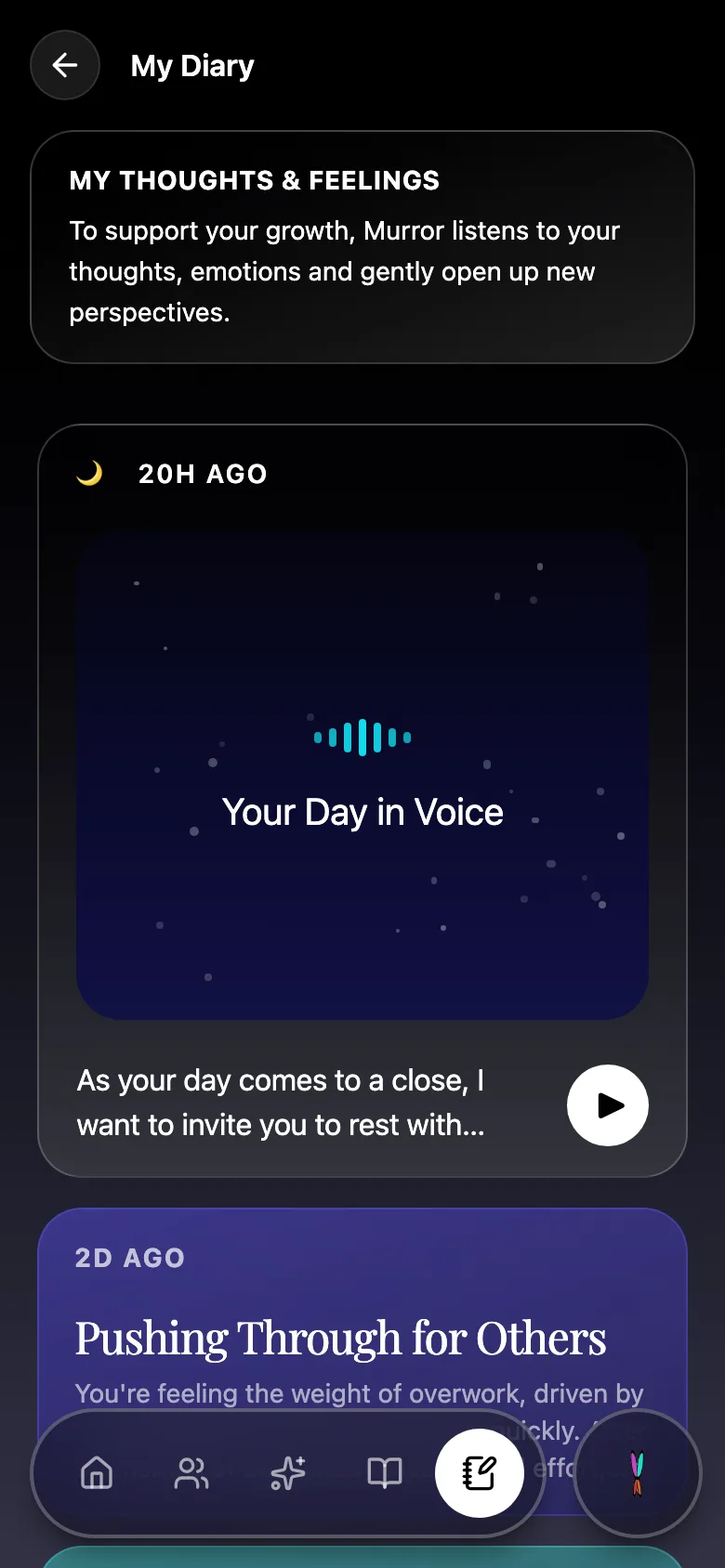
Your history, browsable
Every entry, findable in a glance.
Every entry in your diary list gets an AI-generated short title and a faint preview line, so your history is easy to scan and return to. No more walls of raw text.
Open your Diary list.
Each entry shows a short human-readable title: "Pushing Through for Others," "Your Day in Voice."
A faint preview line gives you the first breath of what was inside.
Tap any entry to read it in full.
Why different
A list of dates and raw text is hard to navigate emotionally. A titled, previewed history lets you find the entry you are looking for, or stumble on one you had forgotten, without having to read everything to find it.
Narrative identity research suggests that how we organize and title our own stories shapes how we remember and understand ourselves. Giving an experience a name makes it more retrievable and easier to build meaning from, though the direct effects of titled entries are lightly studied.
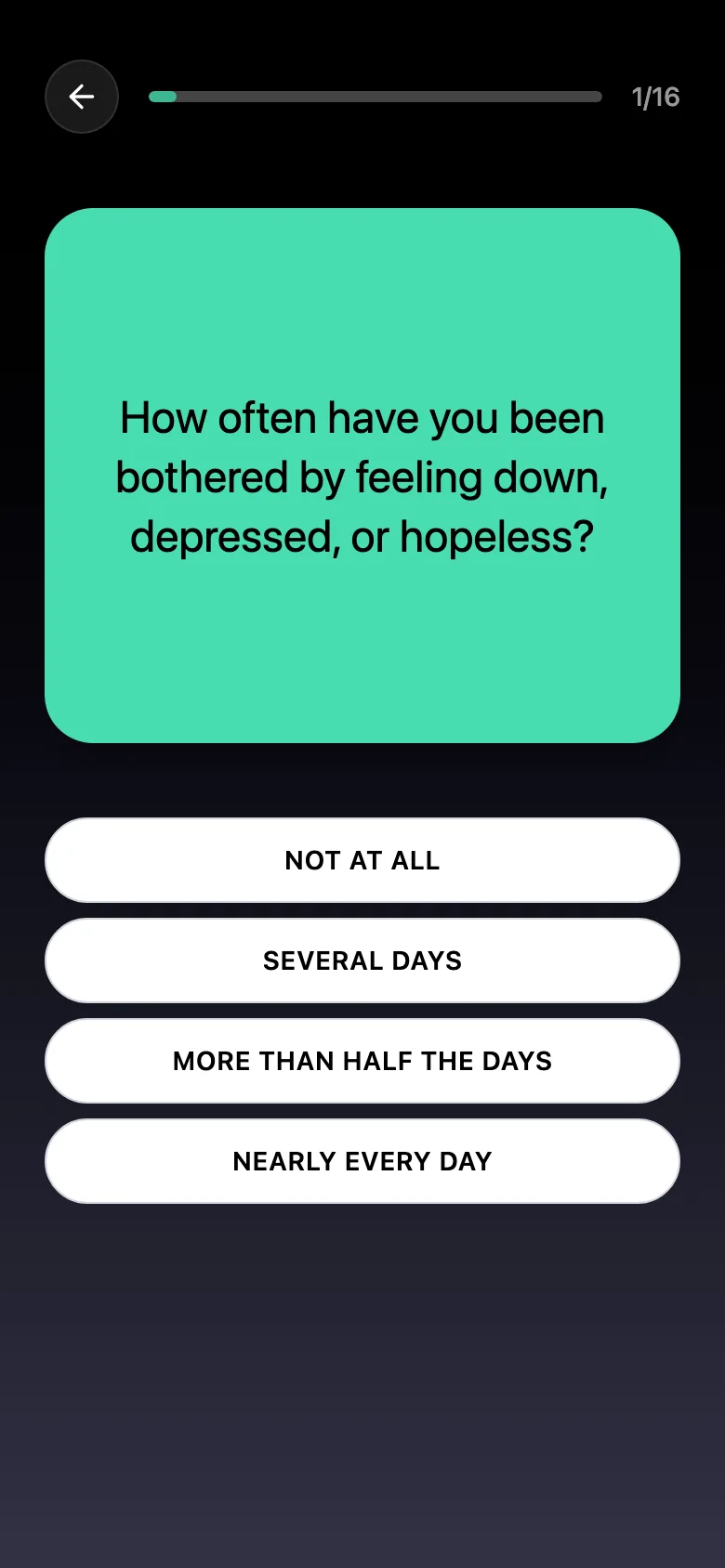
Gentle Check-in
A soft question about how you have really been.
A one-question-at-a-time self-check on how you have been feeling, presented softly, with clear and non-clinical results. If things are heavy, help is one tap away, never buried.
Open the check-in when you feel ready. There is no pressure.
Answer one question at a time, at your own pace.
Get a clear, caring summary of what your answers suggest.
If the results are heavy, immediate resources appear right there.
Why different
Normalizing the act of checking in is the point. Asking yourself how you have been is a small act of care, not a clinical procedure. And if someone needs more support, the path to it should never be hidden.
Brief validated self-screens help people notice when to reach for more support. Self-awareness about emotional state is a starting point, not a diagnosis.
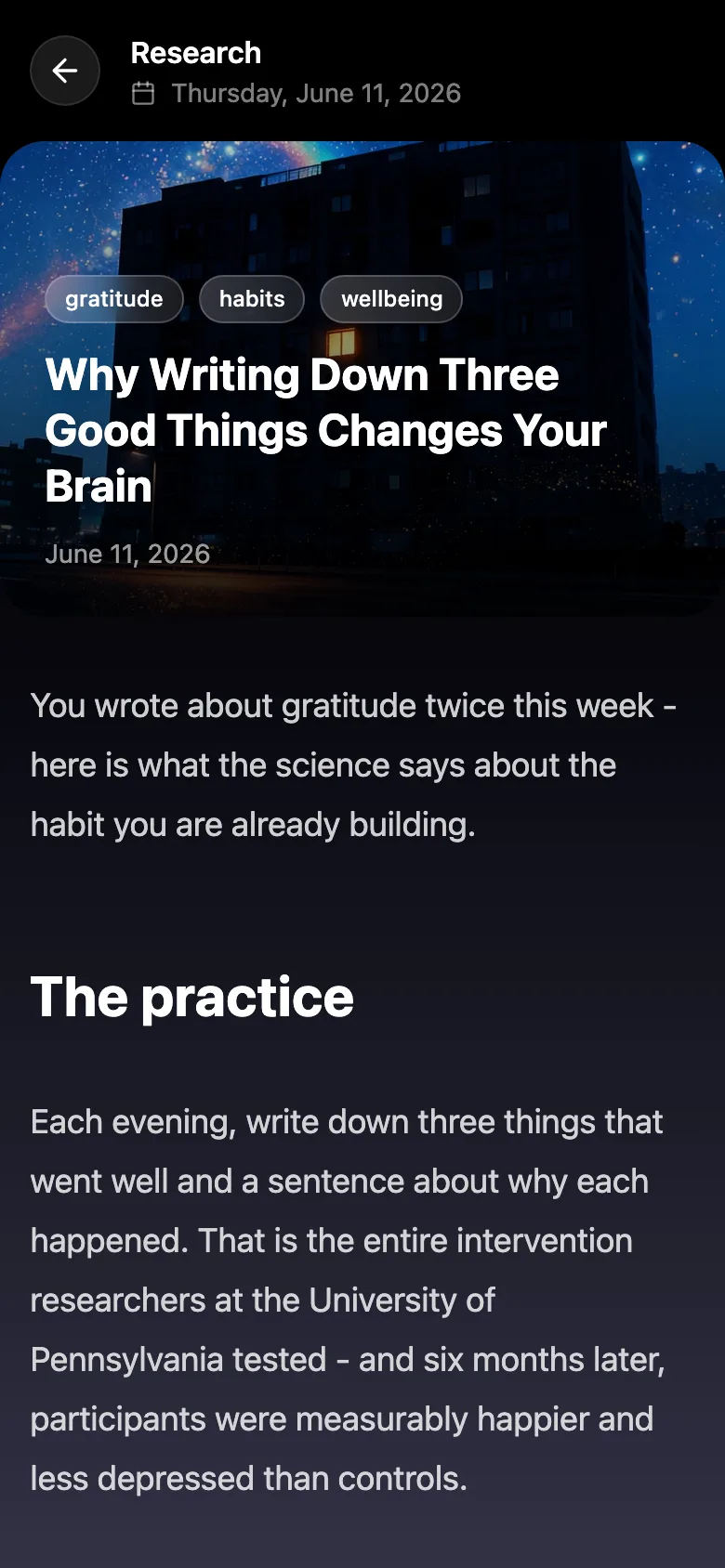
Research, tuned to you
Short articles that know what you have been going through.
Murror writes short research articles tuned to what you have actually reflected on, drawn from trusted sources and cited. If you wrote about gratitude twice this week, an article on the Three Good Things practice appears, personalized to your pattern.
Reflect as usual.
An article card appears on your home feed, tied to a theme from your recent entries.
The article names your pattern: "You wrote about gratitude twice this week."
Read a short, honest piece grounded in real research, with citations.
Tap through to the full source if you want to go deeper.
Why different
Generic self-help rarely fits your situation. Murror researches and writes articles tuned to what you actually reflected on, from real sources, with citations you can follow, so the reading feels relevant rather than randomly recommended.
Gratitude interventions like writing down three good things have shown consistent positive effects on wellbeing in multiple studies, including Seligman et al.'s original work. The effects are real but modest, and tend to fade if the practice becomes mechanical rather than genuine.
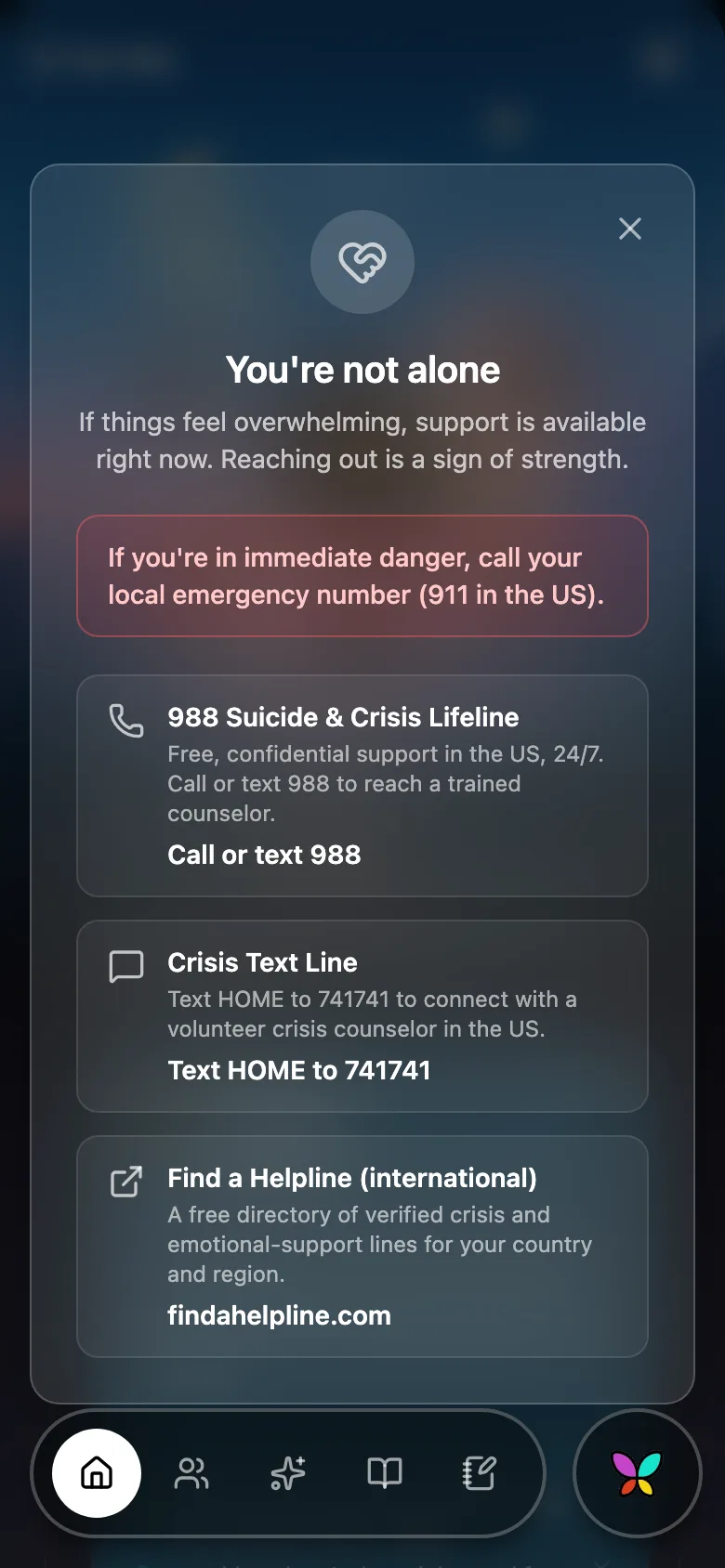
Help, one tap away
Real human support is always here if you need it.
A "You're not alone" sheet listing verified crisis resources: 988 Suicide and Crisis Lifeline, Crisis Text Line, and Find a Helpline for international users. Always one tap from anywhere in the app. Murror is a companion, and these are trained humans.
From any screen, access crisis resources in one tap.
A calm sheet appears listing real, verified hotlines.
988 Suicide and Crisis Lifeline (call or text, US).
Crisis Text Line: text HOME to 741741 (US).
Find a Helpline for international crisis support.
Why different
Murror is not a crisis service and does not try to be one. When things feel overwhelming, trained humans are what help. Murror makes the path to them immediate and never hidden, because in those moments, one extra tap is one too many.
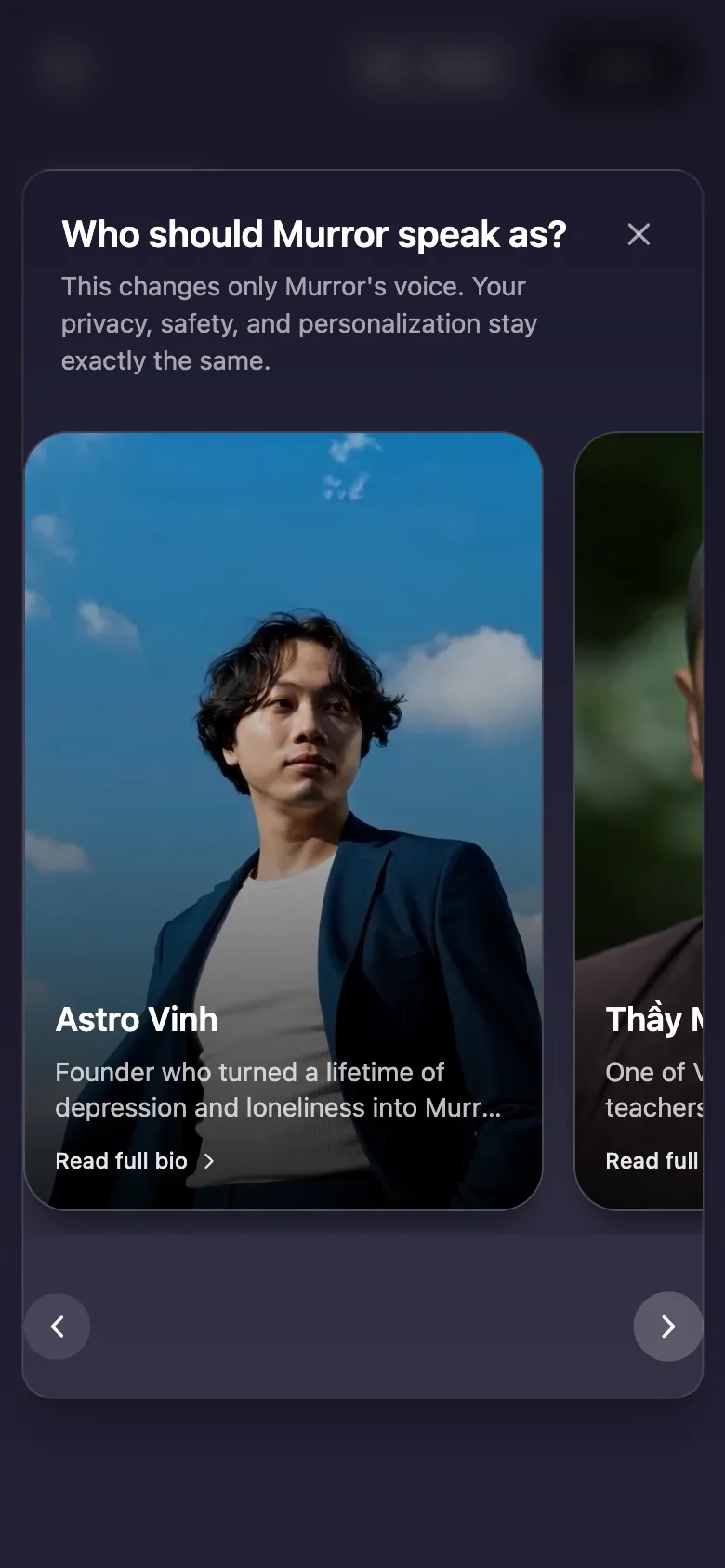
Voices
The voice that reaches you.
You can choose who Murror sounds like: a steady default companion, or a gentler, wiser tone. The voice changes. Your data, your privacy, and your care do not.
From your profile or the composer, tap Choose a voice.
Browse the available companions and pick the one that feels right.
All your entries, history, and personalization stay exactly as they were.
You can switch anytime.
Why different
A relationship, not a bot. Different voices reach different people at different moments. The option to choose is itself an act of care.
Therapeutic alliance, the sense of feeling understood by the other party, predicts outcomes in wellbeing research. Choosing a voice that resonates may support a stronger sense of being heard.

Reflect in your language
Your inner world lives in your mother tongue.
The whole app and the AI reflections work in English, Vietnamese, and Japanese. Not just a translated interface but genuine multilingual understanding: you write in your language and the reflection comes back in the same voice.
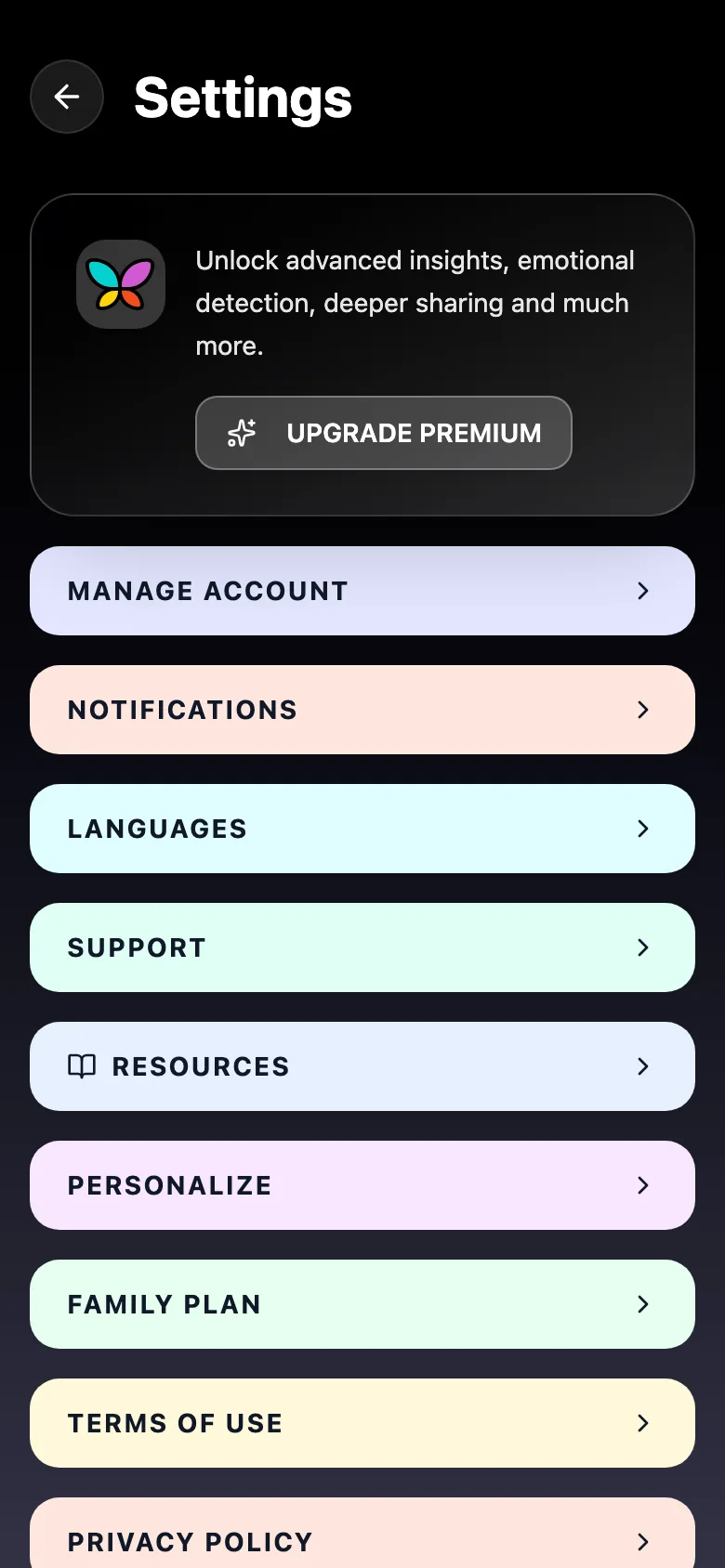
Go to Settings and choose your language.
The full app switches: navigation, prompts, and reflections.
Write in English, Vietnamese, or Japanese.
The AI responds in the same language, with the same depth.
Why different
Many apps offer translated menus but English-only AI. Murror's reflections understand and respond in all three languages, because the feelings you reach for in your first language are often the most honest ones.
Research on emotional expression suggests people often access richer, more specific emotional language in their native tongue, particularly for complex or personal feelings. The practical implication is that a tool that only works in a second language may miss something important.
Privacy
Yours, by design.
Your inner world is private by default. You choose, granularly, what you ever share and with whom. Nothing leaves without your explicit action.
Every entry is private to you by default.
Choose to share a specific takeaway with a specific connection.
No one, not even Murror, reads your entries for any purpose other than powering your own reflections.
You can delete your data at any time.
Why different
You cannot be fully honest with something you do not trust. Privacy is not a feature Murror bolted on. It is the precondition that makes everything else possible.
Self-disclosure is associated with wellbeing benefits, but only in contexts where people feel safe. A sense of control over one's own information reduces the psychological cost of honesty.
And the rest
The rest of the space.
A few more things worth knowing: the experience-first onboarding that meets you where you are, the diary timeline that holds your full history in one scroll, and the Knowledge Hub where the science behind Murror lives.
Onboarding asks about you, not your goals, so Murror knows how to listen before you write a word.
The diary timeline is your full history: every entry, every day, scrollable in one place.
The Knowledge Hub collects honest guides on opening up, loneliness, and self-reflection.
Why different
Most apps optimize for activation. Murror optimizes for the moment you open it on a hard day and it already knows you.
The research is clear on what helps.
Feeling genuinely heard, naming what you feel, and staying close to the people who matter: these are not wellness trends. They are among the best-supported interventions in the field. The effects are real, though modest, and they compound. That is what Murror is built around.
Sources: Lieberman et al., Putting Feelings into Words: Affect Labeling Disrupts Amygdala Activity in Response to Affective Stimuli, Psychological Science (2007); Vine et al., Natural emotion differentiation despite limited emotional vocabulary: A comparison of alexithymia and low emotional granularity, Nature Communications (2020); Frattaroli, Experimental Disclosure and Its Moderators: A Meta-Analysis, Psychological Bulletin (2006, 146 studies, modest effect); Kross & Ayduk, Making Meaning out of Negative Experiences by Self-Distancing, Current Directions in Psychological Science (2011); Holt-Lunstad, Smith & Layton, Social Relationships and Mortality Risk: A Meta-Analytic Review, PLOS Medicine (2015); U.S. Surgeon General, Our Epidemic of Loneliness and Isolation (2023).
Start where you are.
Free to download. No account required to begin.
Murror is a companion for reflection and connection. It is not therapy or medical care. If you are in crisis, please contact your local emergency services or a crisis line.